Toggle light / dark theme

Japan probe finds scars of micrometeoroid bombardment on asteroid Ryugu

Direct sample analysis offers several advantages over robotic explorers conducting it from the surface of an asteroid or planet and then beaming back the data.

It provides a window into understanding how the surface of a celestial body has changed due to its constant exposure to the harsh deep space environment.

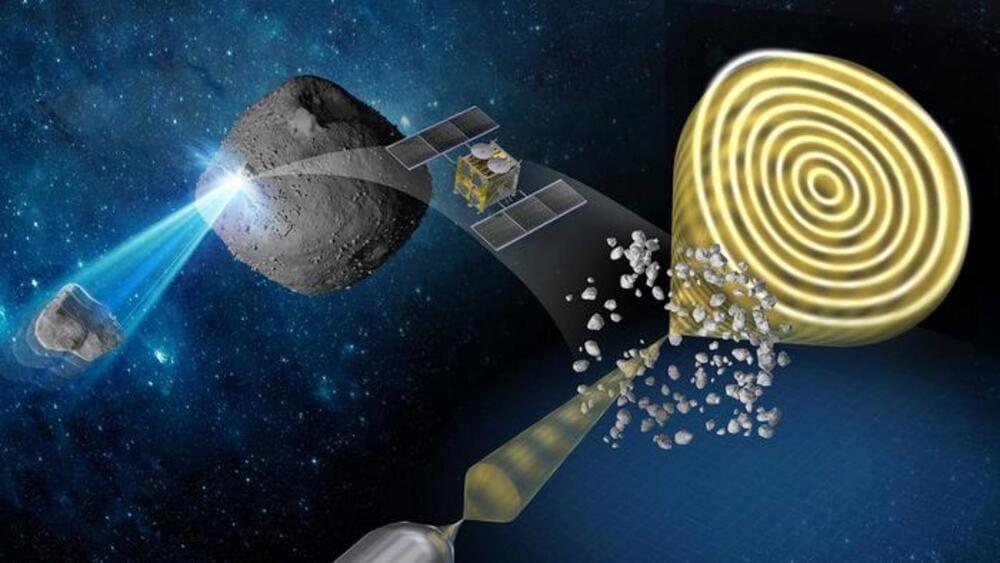
The scientists conducted their analysis using electron holography, a technique in which electron waves infiltrate materials. This method has the potential to uncover key details about the sample’s structure and magnetic and electric properties.

The 7 Strangest Coincidences in the Laws of Nature

Get started on your science revolution with Brilliant! First 30 days are free and 20% off the annual premium subscription when you use our link ➜ https://brilliant.org/sabine.

The universe seems to be ruled by equations and numbers. But why just these equations and why just those numbers? Is it just coincidence? In this video I have collected seven of the weirdest coincidences in physics.

This video comes with a quiz: https://quizwithit.com/start_thequiz/.

🤓 Check out my new quiz app ➜ http://quizwithit.com/
💌 Support me on Donorbox ➜ https://donorbox.org/swtg.
📝 Transcripts and written news on Substack ➜ https://sciencewtg.substack.com/
👉 Transcript with links to references on Patreon ➜ / sabine.
📩 Free weekly science newsletter ➜ https://sabinehossenfelder.com/newsle
👂 Audio only podcast ➜ https://open.spotify.com/show/0MkNfXl
🔗 Join this channel to get access to perks ➜
/ @sabinehossenfelder.
🖼️ On instagram ➜ / sciencewtg.

#physics #astrophysics #science

NASA’s Juno Spacecraft Stumbled On A Glistening Lava Lake On Jupiter’s Moon Io

NASA’s Juno spacecraft recently spotted a glassy-smooth lava lake amid the volcanic hellscape of Jupiter’s moon Io.

When Juno’s orbit swooped past Io last December, its cameras captured a mirrorlike reflection from a small patch of the moon’s surface. The strangely shiny landmark turns out to be a lava lake, covered with a thin crust of smooth, gleaming volcanic rock. The rock was probably something like obsidian, a natural glass that forms from cooling magma here on Earth. Known as Loki Patera, the lava lake stretches 127 miles long and is dotted with rocky islands, and its edges glow with heat from the molten magma just beneath the surface.

Loki Patera isn’t the first lava lake scientists have spotted on Io; previous spacecraft, including Galileo (RIP) have also sent home images of similar features, but Juno’s pics are the clearest and most detailed. Based on Juno’s data, NASA created this animation of what a flight over Loki Patera might look like.

CSIRO Telescope detects unprecedented Behaviour from Nearby Magnetar

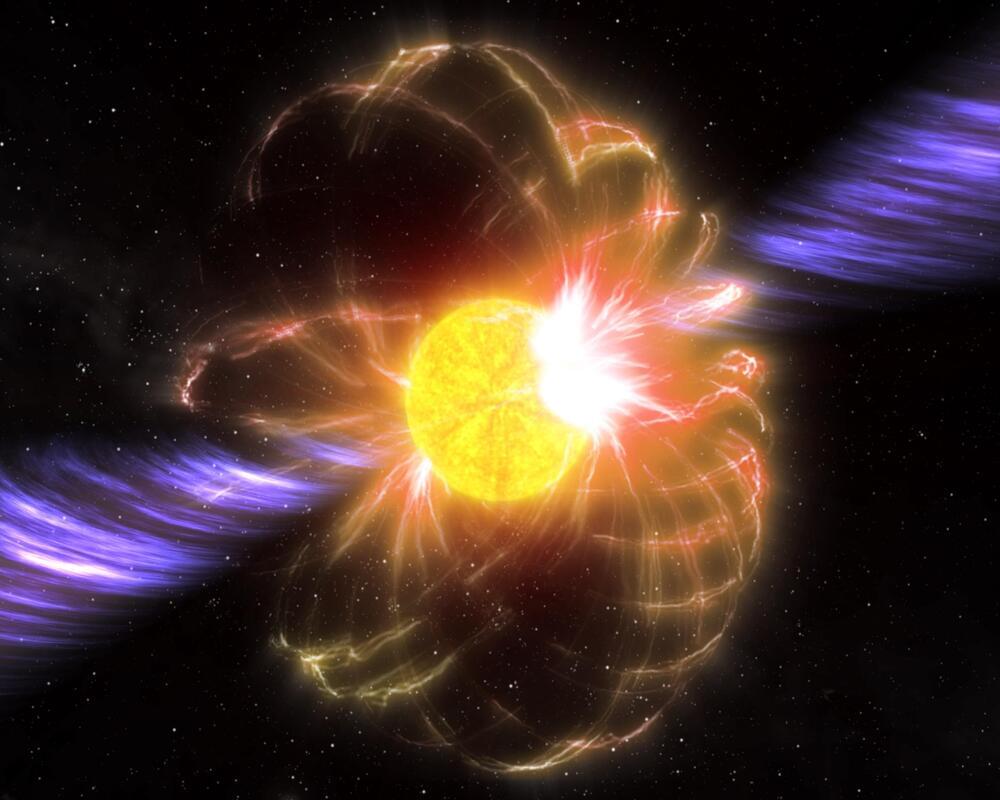
Researchers using Murriyang, CSIRO’s Parkes radio telescope, have detected unusual radio pulses from a previously dormant star with a powerful magnetic field.

New results published today in Nature Astronomy describe radio signals from magnetar XTE J1810-197 behaving in complex ways.

Magnetars are a type of neutron star and the strongest magnets in the Universe. At roughly 8,000 light years away, this magnetar is also the closest known to Earth.

Russia vetoes U.N. resolution on nuclear weapons in space

WASHINGTON — Russia, as expected, vetoed April 24 a United Nations Security Council resolution crafted in response to reports that the country was developing a nuclear anti-satellite weapon.

Russia cast the only vote against the draft resolution that reaffirmed provisions in the Outer Space Treaty prohibiting the placement of nuclear weapons or other weapons of mass destruction in space. Thirteen other members of the Security Council voted in favor of the resolution while China abstained. As a permanent member of the Security Council, though, Russia’s vote acted as a veto preventing adoption of the resolution.

Japan and the United States drafted the Security Council resolution, which they billed as the first devoted to outer space issues. The resolution directed members to uphold Article 4 of the Outer Space Treaty, which forbids countries from placing nuclear weapons in orbit or on celestial bodies. It also called on countries not to develop nuclear weapons or other weapons of mass destruction specifically designed to be placed in orbit.

Review of electron emission and electrical breakdown in nanogaps

With the continual miniaturization of electronic devices, there is an urgent need to understand the electron emission and the mechanism of electrical breakdown at nanoscale. For a nanogap, the complete process of the electrical breakdown includes the nano-protrusion growth, electron emission and thermal runaway of the nano-protrusion, and plasma formation. This review summarizes recent theories, experiments, and advanced atomistic simulation related to this breakdown process. First, the electron emission mechanisms in nanogaps and their transitions between different mechanisms are emphatically discussed, such as the effects of image potential (of different electrode’s configurations), anode screening, electron space-charge potential, and electron exchange-correlation potential. The corresponding experimental results on electron emission and electrical breakdown are discussed for fixed nanogaps on substrate and adjustable nanogaps, including space-charge effects, electrode deformation, and electrical breakdown characteristics. Advanced atomistic simulations about the nano-protrusion growth and the nanoelectrode or nano-protrusion thermal runaway under high electric field are discussed. Finally, we conclude and outline the key challenges for and perspectives on future theoretical, experimental, and atomistic simulation studies of nanoscale electrical breakdown processes.
/* */