Toggle light / dark theme

New cavity control strategy improves performance of blue vertical-cavity surface-emitting lasers

GaN-based vertical-cavity surface-emitting lasers (VCSELs) are promising for displays, sensing and optical communication, but improving efficiency remains challenging. Researchers have now shown that “cavity tuning,” which controls resonance wavelength, strongly affects laser performance. By analyzing variations across a VCSEL wafer, the team identified optimal mirror loss conditions and extracted device parameters. Their approach achieved 26.4% wall plug efficiency, offering guidance for next-generation high-efficiency visible-light semiconductor lasers.

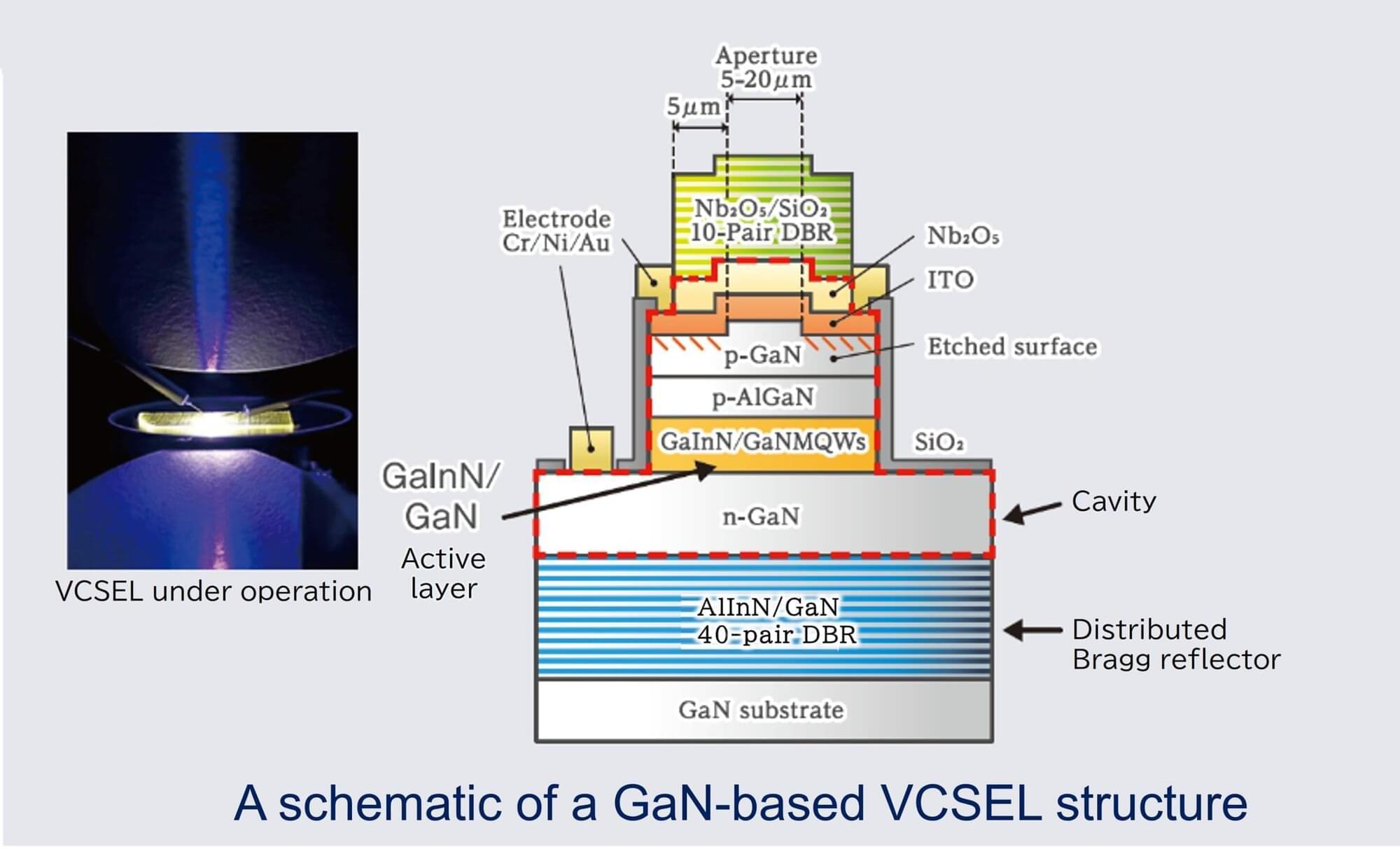
Gallium nitride (GaN)-based vertical-cavity surface-emitting lasers, or VCSELs, are attracting increasing attention as compact and energy-efficient light sources for future technologies. These semiconductor lasers are considered promising for applications such as next-generation displays, biometric sensing, environmental monitoring and short-range optical communication. However, improving their efficiency has remained a major challenge because laser performance depends strongly on precise optical design and cavity control.

Addressing this challenge, a research team led by Professor Tetsuya Takeuchi, Professor Satoshi Kamiyama and Professor Motoaki Iwaya from the Department of Materials Science and Engineering, Meijo University, Japan, along with Mr. Naoki Shibahara, first author and graduate student at the Graduate School of Science and Technology, Meijo University, Japan, investigated how “cavity tuning” influences the lasing characteristics of GaN-based VCSELs. While conventional studies mainly focused on gain tuning, also known as detuning, the researchers demonstrated that resonance wavelength alignment relative to the distributed Bragg reflector center wavelength critically affects laser operation.


Claude Fable 5: Why This Time is Different

Anthropic has released Claude Fable 5, the public version of a model it once said was too dangerous to ship.

Ethan Mollick spent years describing AI use as casting spells, and now he’s not sure he’s the wizard anymore.

The model ran for nine and a half hours unsupervised and delivered working software he could barely fault.

But the same system hands its most dangerous capabilities to the NSA while the public gets the sanded-down version.

This video asks what it means when the most useful AI is also the least legible.

Sources to Google.

NSA Releases Hundreds of Pages of Formerly Top Secret UMBRA UAP Records After Disclosure Foundation FOIA Appeal

The National Security Agency has produced hundreds of pages of historical UAP-related records following a Freedom of Information Act appeal by the Disclosure Foundation. Many of the records were previously classified “TOP SECRET UMBRA,” one of the most sensitive classification markings associated with signals intelligence.

The DOJ Is Demanding Apple And Google Identify Over 100,000 Users Of This Car App

In the letter, EZ Lynk lawyers wrote that Apple and Google are planning to fight the subpoenas. Walmart declined to comment. None of the other companies subpoenaed responded to a comment request.

“These requests for potentially hundreds of thousands of people’s PII go well beyond the needs of this case and create serious privacy concerns,” wrote EZ Lynk’s lawyers in the letter. “Investigating this claim does not require identifying each person who has used the product.”

The government said in the letter its request for data was fair and appropriate, and it had “consistently sought customer information” because its lawyers want to interview witnesses about their use of EZ Lynk’s technology. It has already presented evidence to the court of people using the company’s tools to remove emissions controls on their cars, including Facebook and EZ Lynk forum posts outlining that use of the product.

Aivela Takes a Different Spin on the Health-Tracking Smart Ring

Smart rings are no longer novel. A few hidden superpowers, however, might make them interesting again.

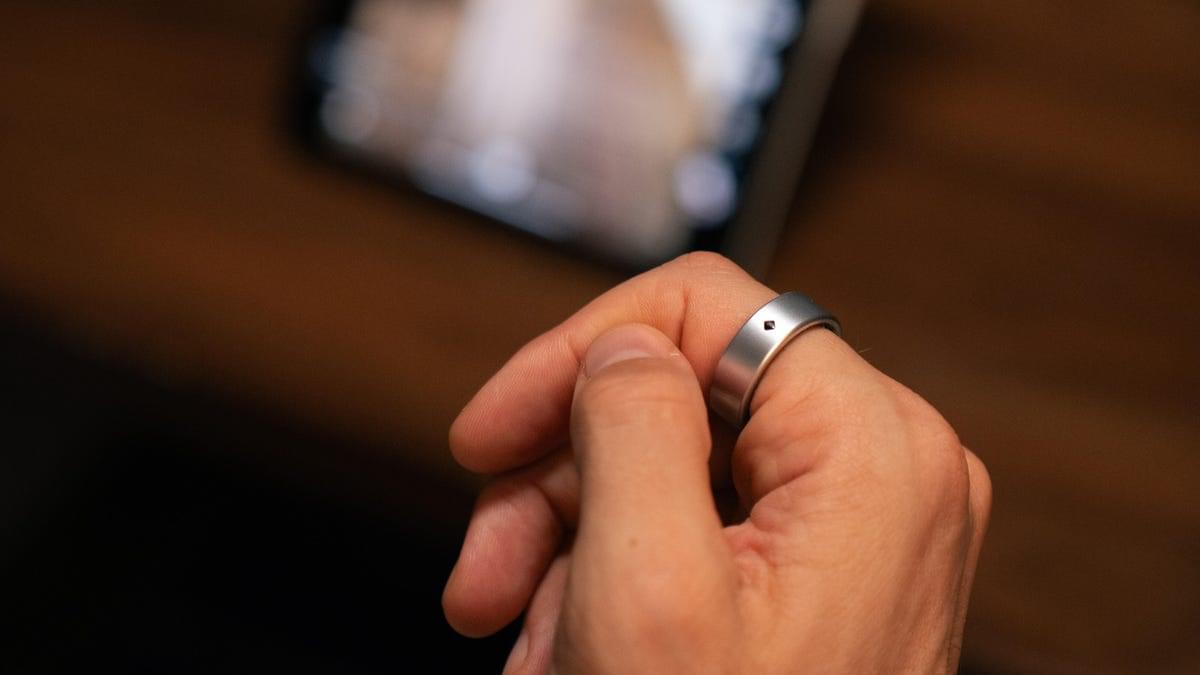
Most devices are increasingly focused on biometric tracking. The Aivela Ring Pro aims to stand out with stealth gesture and touch controls. With a stealth flick, swipe or slide of the finger, you can control music playback, adjust volume, trigger the camera, advance slide decks, scroll and more on your phone.

Launched at CES 2026, the Ring Pro resembles many of its competitors, including the Oura Ring and Samsung’s Galaxy Ring. There’s only so much you can do with ring design after all. It has the familiar metallic (scratch-resistant) finish, a slightly thicker top profile and sensors lining the interior. The primary visual cue indicating something different is a small diamond-shaped engraving at the center, which signals the location of the touchpad.

MXene-based e-tattoos harvest energy and monitor health in real time

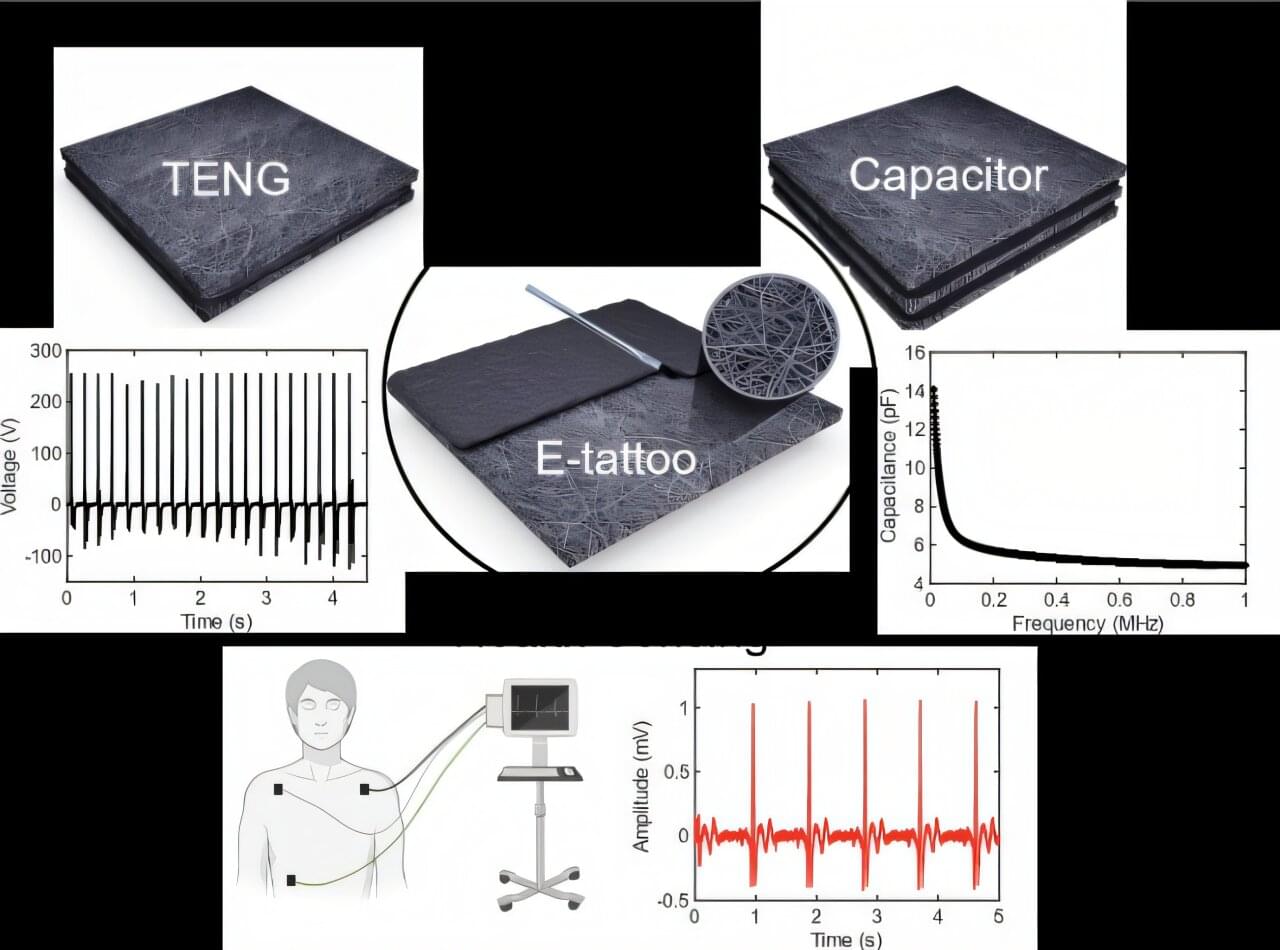
Researchers at Boise State University have developed a breakthrough in wearable electronics: a multifunctional electronic tattoo (e‑tattoo) that integrates energy harvesting, energy storage, and real‑time biometric sensing into a single, skin‑conformal platform.

The innovation leverages electrospun poly(vinyl butyral‑co‑vinyl alcohol‑co‑vinyl acetate) (PVBVA) fibers coated with titanium carbide (Ti₃C₂Tₓ) MXenes, offering a scalable, biocompatible, and durable alternative to conventional wearable devices that often rely on rigid substrates or external gels.

The work is published in the journal Advanced Science.

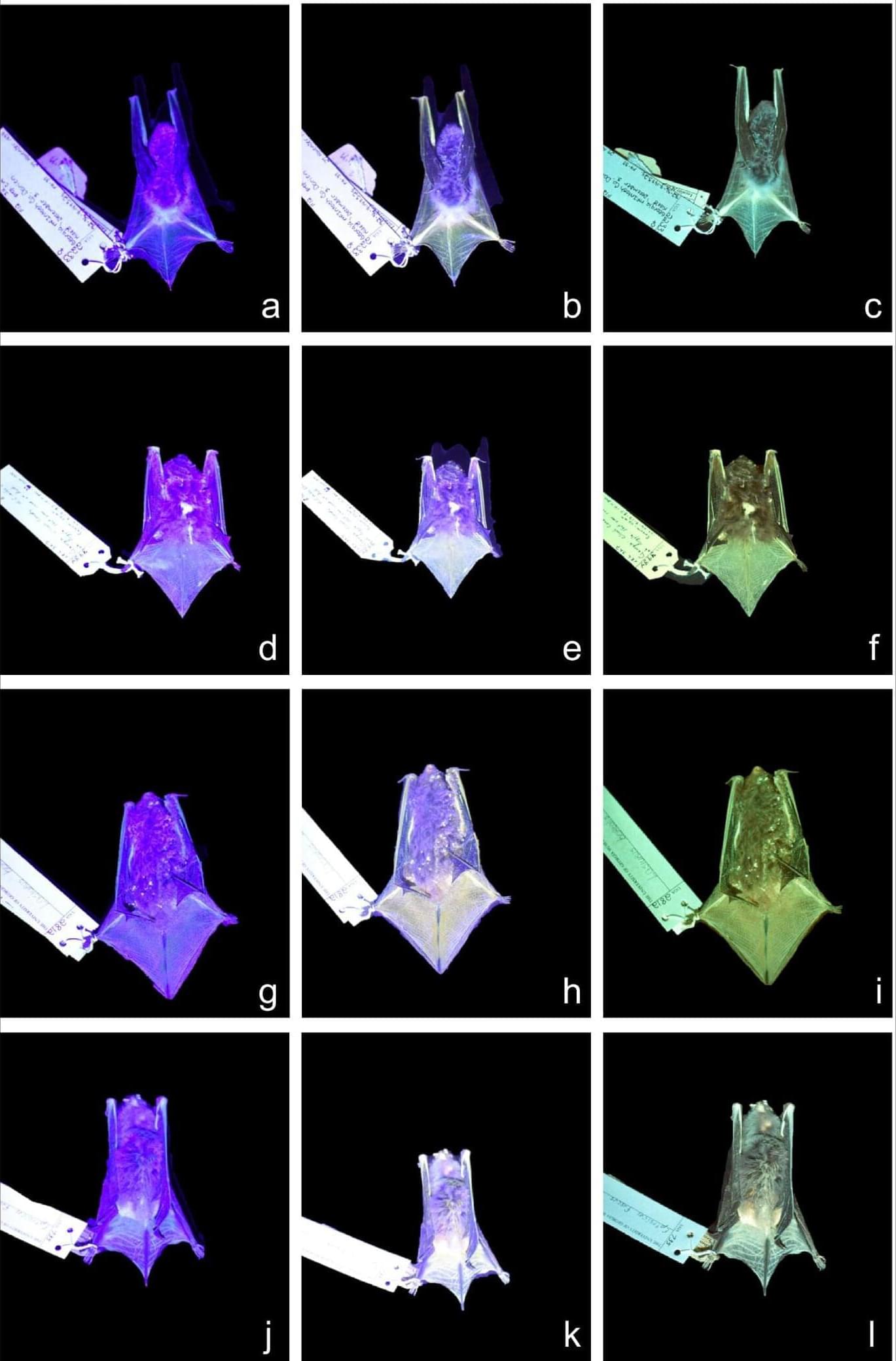
Glowing Green: A Quantitative Analysis of Photoluminescence in Six North American Bat Species

WhatsApp is rolling out passkey-encrypted backups for iOS and Android devices, enabling users to encrypt their chat history using their fingerprint, face, or a screen lock code.

Passkeys are a passwordless authentication method that allows users to sign in using biometrics (such as face recognition or fingerprint), PINs, or security patterns instead of traditional passwords. They enable logging into websites, online services, or apps without needing to remember complex passwords or use a password manager.

When creating a passkey, your device generates a unique cryptographic key pair consisting of a private key stored on the device and a public key sent to the website or app. Because of this, passkeys provide significantly improved security over regular credentials, seeing that they can’t be stolen in data breaches because the private key never leaves your device.

/* */