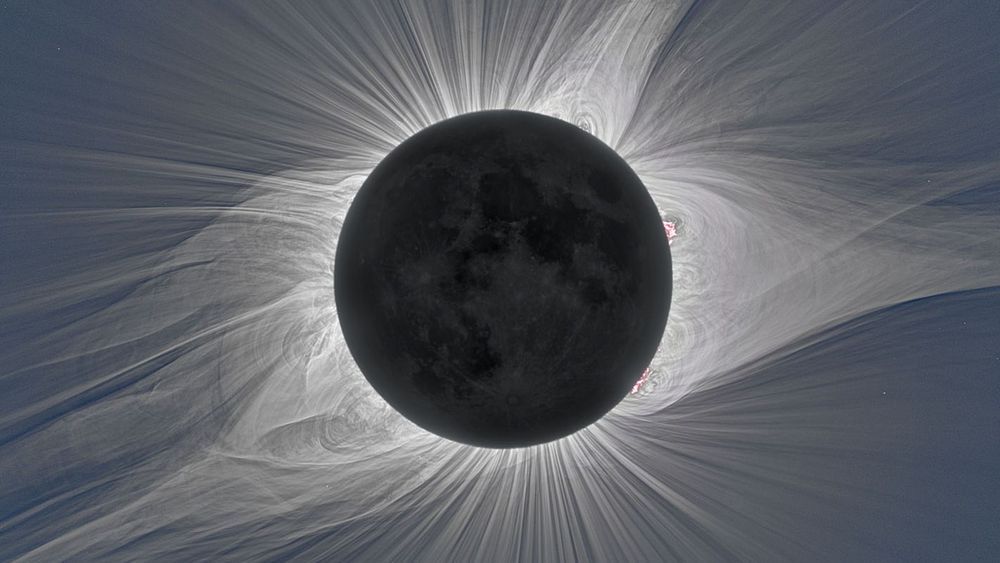
Next month, a total solar eclipse will pass over a slice of the South Pacific, Chile, and Argentina—and directly over an observatory in the Andes run by the National Science Foundation.
Astronomers and physicists are now preparing the experiments they plan to run during the eclipse. As with past eclipses, these experiments will focus on observing the Sun, as well as the effects of eclipses on Earth.
As even casual Star Wars fans will know, lightsabers are probably the coolest weapon ever to make an appearance on the big screen. Lightsaber fights are so elegant that they are almost hypnotic and, even though not all of us might have a strong enough flow of Force running through our veins, a lightsaber in the right hand is by far the deadliest weapon to be found in the universe.
The idea behind a lightsaber is simple genius: a light-weight and immensely powerful tool that uses a blade of energy to not only slice up disciples of the Dark Side in a single blow but also act as an effective shield against laser blasts. So why don’t we have working lightsabers in real life? Surely physicists must be smart enough (and big enough Star Wars fans) to be able to produce one of these incredible objects.
The obvious way of building a lightsaber would be to use a laser, which can be seen as a particularly bright and directional burst of light. But even though laser technology is continuously striding towards more efficient and practical machines, we are still miles away from a working lightsaber. Let’s see why.
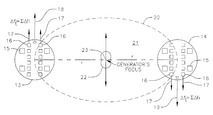
A gravitational wave generating device comprising an energizing means such as magnetrons, which act upon energizable elements such as film bulk acoustic resonators or FBARs. A computer that controls the magnetrons’ phase. A gravitational wave generation device that exhibits directivity and forms a gravitational-wave beam. The utilization of a medium in which the gravitational wave speed is reduced in order to effect refraction of the gravitational wave and be a gravitational wave lens. A gravitational wave generator device that can be directed in order to propel an object by its momentum or by changing the gravitational field nearby the object to urge it in a preferred direction and be a propulsion means.
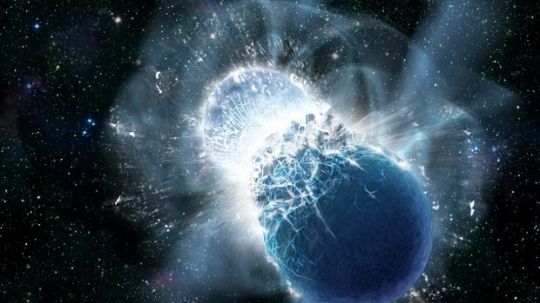
When he was considering white dwarfs and neutron stars in the context of what he called ‘gravitational machines,’ Freeman Dyson became intrigued by the fate of a neutron star binary. He calculated in his paper of the same name (citation below) that gradual loss of energy through gravitational radiation would bring the two neutron stars together, creating a gravitational wave event of the sort that has since been observed. Long before LIGO, Dyson was talking about gravitational wave detection instruments that could track the ‘gravitational flash.’
Image: Artist conception of the moment two neutron stars collide. Credit: LIGO / Caltech / MIT.
Gold, silver and copper are heavy metals, but LLNL scientists can now make them nearly as light as air—in a form so tiny it can ride on a mosquito’s back.
The groundbreaking science, part of a joint NIF/Physical and Life Sciences (PLS) project supported by the Laboratory Directed Research and Development (LDRD) Program, created these ultra-low density metalfoams to give physicists better X-ray sources to employ in experiments that support NIF’s Stockpile Stewardship mission.
The foam is the product of a nearly decade-long research effort by members of the Lab’s NIF and PLS directorates for use on inertial confinement fusion (ICF) experiments at NIF, the world’s most energetic laser system.