NASA’s new plan for orbit conjures a striking view of government and commerce in space.
Read more

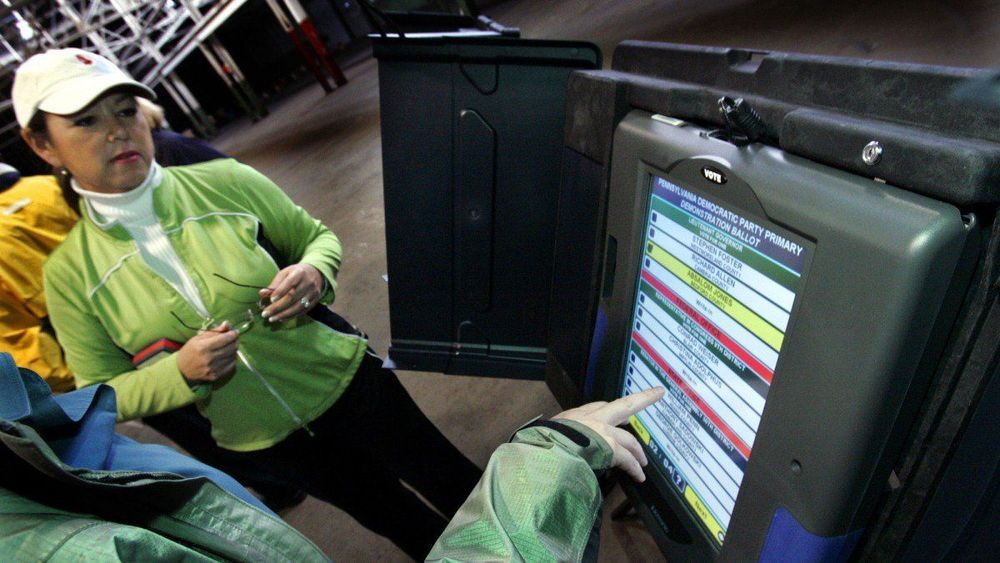
Low tech sometimes is really good because when systems can be exploited then basically you see that no tech is sometimes best.
Election Systems & Software has championed electronic voting machines in the US. Now it has had a change of heart about the need for paper records of votes.
Cyber threats: Over half a million electronic machines are used in big US elections. Many produce paper copies of votes that can be used to audit electronic results, but some don’t. That’s a problem because security experts have shown that machines can be hacked.
The news: Tom Burt, Election Systems & Software’s chief executive, said in an op-ed in the political newspaper Roll Call that it will no longer sell paperless voting machines as the primary voting device in jurisdictions. Burt also called on Congress to make paper backups mandatory for all electronic votes cast, and to require all voting equipment suppliers to submit their machines to robust cybersecurity testing.
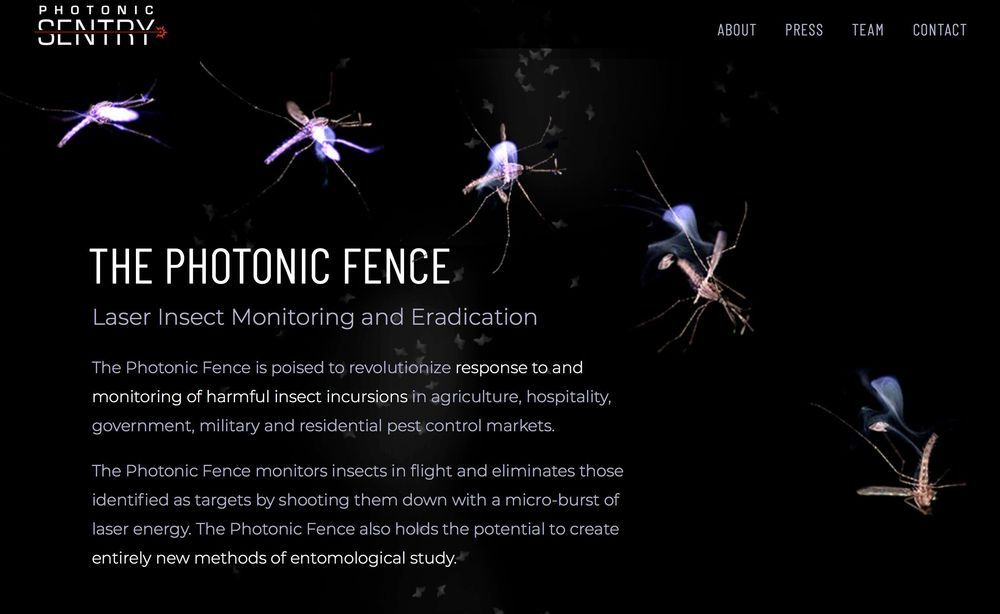
THE PHOTONIC FENCE:
Laser Insect Monitoring and Eradication.
The Photonic Fence is poised to revolutionize response to and monitoring of harmful insect incursions in agriculture, hospitality, government, military and residential pest control markets.
The Photonic Fence monitors insects in flight and eliminates those identified as targets by shooting them down with a micro-burst of laser energy. The Photonic Fence also holds the potential to create entirely new methods of entomological study.

A new one-off prostate cancer test at the age of 55 promises to give men “peace of mind” that they will never develop the disease, scientists have revealed.
The 10-minute scan, which could be rolled out in supermarkets and shopping centres, detects dangerous cancers years before they cause any harm while ignoring growths that do not pose a threat.
Subject to a government-funded trial beginning this summer, the new MRI (magnetic resonance imaging) technique should enable the world’s first universal screening programme for prostate cancer.
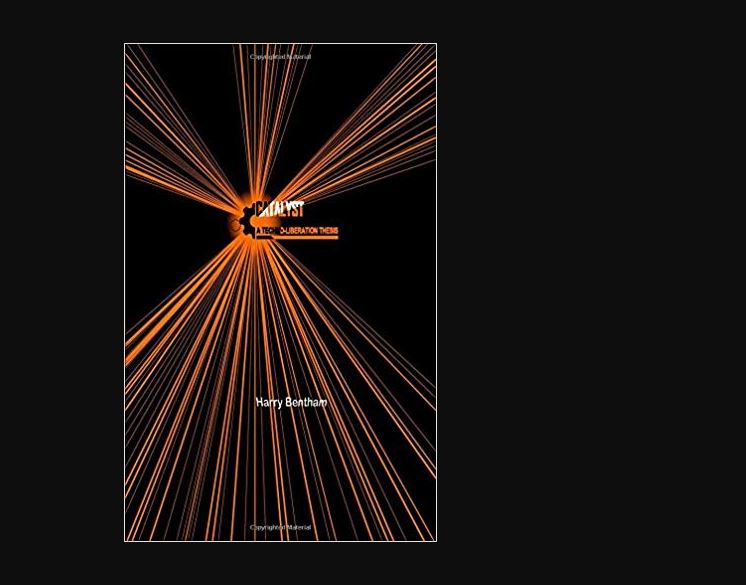
My own 2013 book Catalyst: A Techno-Liberation Thesis offered a prediction of the political future, viewing the near-term future as a time of crisis shaped by the nature of technology and the slowness of states to adjust to it. As this struggle becomes more acute, guarded new technologies will also get stolen and overflow across borders, going global and penetrating every country before they were intended to. States and large companies will react with bans and lies as they try to save their monopolies. Ultimately, over a longer time-frame, the nation-state system will collapse because of this pressure and an uncertain successor system of governance will emerge. It will look like “hell on earth” for a time, but it will stabilize in the end. We will become new political animals with new allegiances, shaped by the crisis, much as the Thirty Years’ War brought about our Westphalian nation-state model. Six years on from my book, are we any closer to what I predicted?
Catalyst is read in less than a day, and can be found on Kindle as well as in print. It was written to bring together a number of ideas and predictions I presented in articles at the IEET website, h+ Magazine, and other websites and includes full lists of sources. If you prefer to see more first, follow @CatalystThesis on Twitter or sign up to the email newsletter.

A month after the fire that ravaged the Notre Dame Cathedral in Paris, scientists and research bodies are getting organized to help restore the building—and advance scientific knowledge.
At a public hearing held yesterday by France’s Parliamentary Office for the Evaluation of Scientific and Technological Options (OPECST), academics explained how they can contribute to the government’s efforts to restore the cathedral, which was partly destroyed on 15 April.
“This catastrophe is, in the end, a privileged moment for research, because we’ll have access to materials that we otherwise wouldn’t be able to access,” said Martine Regert, deputy scientific director of the Institute of Ecology and Environment at the French national research agency CNRS. For example, analyzing certain isotopes in the cathedral’s timber frame could provide insights about the medieval climate, said Philippe Dillmann, a research leader at CNRS’s Institute for Research on Archeomaterials.
The US government quietly resumed funding experiments on the deadly H5N1 avian flu — research that makes the virus more easily transmissible to mammals.
The researchers say making new strains of the H5N1 flu virus in a secure lab can help them see what might happen naturally in the real world. Sounds logical, but many scientists oppose it because the facts show most biosafety labs aren’t really secure at all, and experts say the risks of a mutated virus escaping outweigh whatever public health benefit comes from creating them.
But now the US government is funding these same labs again to artificially enhance potentially pandemic pathogens.
Say WHAT?
In this installment of the Bulletin’s video series that provides a sharp view of fuzzy policy, Johns Hopkins University computational biologist Steven Salzberg explains why arguments by researchers in favor of risky viral research aren’t persuasive.

DARPA, the Department of Defense’s research arm, is paying scientists to invent ways to instantly read soldiers’ minds using tools like genetic engineering of the human brain, nanotechnology and infrared beams. The end goal? Thought-controlled weapons, like swarms of drones that someone sends to the skies with a single thought or the ability to beam images from one brain to another.
This week, DARPA (Defense Advanced Research Projects Agency) announced that six teams will receive funding under the Next-Generation Nonsurgical Neurotechnology (N3) program. Participants are tasked with developing technology that will provide a two-way channel for rapid and seamless communication between the human brain and machines without requiring surgery.
“Imagine someone who’s operating a drone or someone who might be analyzing a lot of data,” said Jacob Robinson, an assistant professor of bioengineering at Rice University, who is leading one of the teams. [DARPA’s 10 Coolest Projects: From Humanoid Robots to Flying Cars].

Governments are becoming ever more reliant on digital technology, making them more vulnerable to cyber attacks. In 2007, Estonia was attacked by pro-Russian hackers who crippled government servers, causing havoc. Cyber attacks in Ukraine targeted the country’s electricity grid, while Iran’s nuclear power plants were infected by malware that could have led to a nuclear meltdown.
In the US, president Trump recently declared a “national emergency” to recognise the threat to US computer networks from “foreign adversaries”.
Politically-motivated cyber attacks are becoming increasingly commonplace but unlike traditional warfare between two or more states, cyberwarfare can be launched by groups of individuals. On occasion, the state is actually caught in the crosshairs of competing hacking groups.
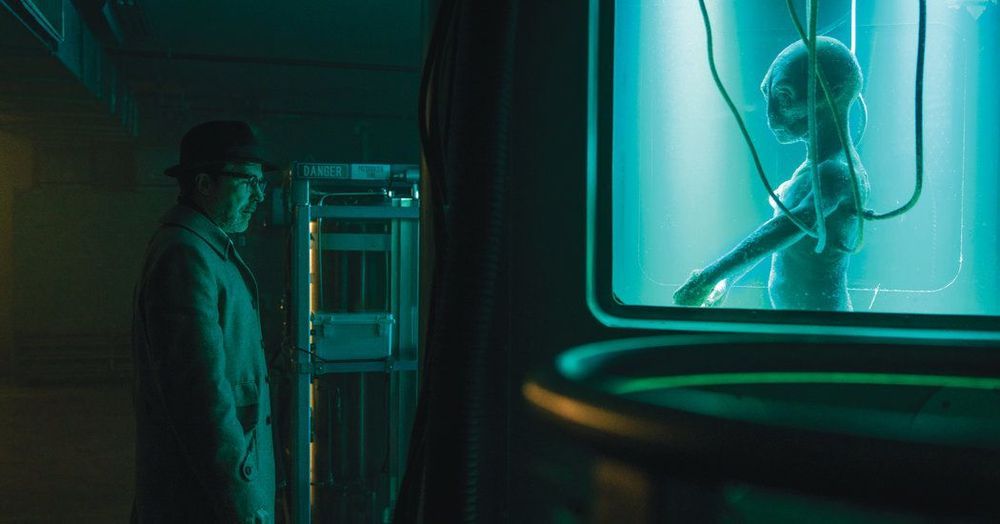
Featuring a Russian spy murder, a self-immolation, gun-toting government thugs and other fanciful plot devices, “Project Blue Book,” History’s popular new series on the Air Force’s program to investigate and debunk U.F.O.s, is not your historian’s Project Blue Book.
We viewed the first six episodes from the standpoint of writers who have long worked on the serious side of U.F.O.s. We broke the December 2017 New York Times exclusive on a secret Pentagon program investigating the phenomenon, with our colleague Helene Cooper. Leslie Kean wrote the Times 2010 best-seller “U.F.O.s: Generals, Pilots and Government Officials Go On the Record.” Ralph Blumenthal has written about U.F.O.s for Vanity Fair as well as The Times.
So, despite the embellishments, we were interested to discover parallels between the TV version and the historical and current reality.