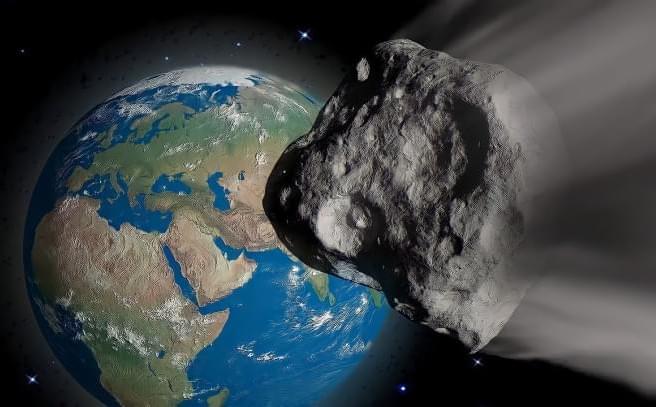
The mission was successful, and Dimorphos’ orbit was shortened by 33 minutes in the weeks after the impact.
However, a team of high school students led by teacher Jonathan Swift at Thacher School in California have discovered that Dimorphos’ orbit continued to shrink by another minute more than a month after the collision.
‘The number we got was slightly larger, a change of 34 minutes,’ said Mr Swift. ‘That was inconsistent at an uncomfortable level.’
Many believe the future of humanity is to go Digital, uploading our minds to computers, living in virtual worlds that are vastly more efficient and compact. If we might do this, might distant alien empires too? And if so, might this be the reason we don’t see them?
Credits: The Fermi Paradox: Digital Empires & Miniaturization. Science & Futurism with Isaac Arthur. Episode 319, December 2, 2021 Written, Produced & Narrated by Isaac Arthur.
Look, we write rather a lot about the Fermi Paradox, so trust us when we say that the Berserker Hypothesis may be the darkest explanation out there. Not only would it mean that the universe is a dead, lifeless husk, but it would also imply that our own destruction is imminent.
The Fermi Paradox at its most basic is, given the high probability that alien life exists out there (bearing in mind the vastness of space and that we keep finding planets within habitable zones), why has nobody got in touch yet?
North Korea-linked hackers have stolen hundreds of millions of crypto to fund the regime’s nuclear weapons programs, research shows.
So far this year, from January to Aug. 18, North Korea-affiliated hackers stole $200 million worth of crypto — accounting for over 20% of all stolen crypto this year, according to blockchain intelligence firm TRM Labs.
“In recent years, there has been a marked rise in the size and scale of cyber attacks against cryptocurrency-related businesses by North Korea. This has coincided with an apparent acceleration in the country’s nuclear and ballistic missile programs,” said TRM Labs in a June discussion with North Korea experts.
SEOUL, Sept 3 (Reuters) — North Korea conducted a simulated tactical nuclear attack drill that included two long-range cruise missiles in an exercise to “warn enemies” the country would be prepared in case of nuclear war, the KCNA state news agency said on Sunday.
KCNA said the drill was successfully carried out on Saturday and two cruise missiles carrying mock nuclear warheads were fired towards the West Sea of the Korean peninsula and flew 1,500 km (930 miles) at a preset altitude of 150 meters.
Pyongyang also said it would bolster its military deterrence against the United States and South Korea.
Asteroid 2021 JA5 is around the size of 81 bulldogs, the symbol of the college football team of the University of Georgia. But it won’t hit us – hopefully the Bulldog team will have better luck.
“It’s a time of huge uncertainty,” says Geoffrey Hinton from the living room of his home in London. “Nobody really knows what’s going to happen … I’m just sounding the alarm.”
In The Godfather in Conversation, the cognitive psychologist and computer scientist ‘known as the Godfather of AI’ explains why, after a lifetime spent developing a type of artificial intelligence known as deep learning, he is suddenly warning about existential threats to humanity.
A University of Toronto University Professor Emeritus, Hinton explains how neural nets work, the role he and others played in developing them and why the kind of digital intelligence that powers ChatGPT and Google’s PaLM may hold an unexpected advantage over our own. And he lays out his concerns about how the world could lose control of a technology that, paradoxically, also promises to unleash huge benefits – from treating diseases to combatting climate change.
Organoid intelligence is an emerging field in computing and artificial intelligence.
Earlier this year, an Australian startup Cortical Labs developed a cybernetic system made from human brain cells. They called it DishBrain and taught it to play Pong.
The roots of this exciting technology go back 60 years. But while it’s still novel today, it’s already superior to conventional deep-learning AI in several aspects. However, it also poses new ethical and existential risks to humanity.
Watch the video to explore how Organoid Intelligence might evolve over the next few decades and how it could fit into our lives.
The 80,000 Hours Podcast features unusually in-depth conversations about the world’s most pressing problems and what you can do to solve them. Learn more, read the summary and find the full transcript on the 80,000 Hours website: https://80000hours.org/podcast/episodes/jan-leike-superalignment.
In July, OpenAI announced a new team and project: Superalignment. The goal is to figure out how to make superintelligent AI systems aligned and safe to use within four years, and the lab is putting a massive 20% of its computational resources behind the effort.
Today’s guest, Jan Leike, is Head of Alignment at OpenAI and will be co-leading the project. As OpenAI puts it, “…the vast power of superintelligence could be very dangerous, and lead to the disempowerment of humanity or even human extinction. … Currently, we don’t have a solution for steering or controlling a potentially superintelligent AI, and preventing it from going rogue.”
Given that OpenAI is in the business of developing superintelligent AI, it sees that as a scary problem that urgently has to be fixed. So it’s not just throwing compute at the problem — it’s also hiring dozens of scientists and engineers to build out the Superalignment team.
Plenty of people are pessimistic that this can be done at all, let alone in four years. But Jan is guardedly optimistic. As he explains:
Honestly, it really feels like we have a real angle of attack on the problem that we can actually iterate on… and I think it’s pretty likely going to work, actually. And that’s really, really wild, and it’s really exciting. It’s like we have this hard problem that we’ve been talking about for years and years and years, and now we have a real shot at actually solving it. And that’d be so good if we did.