Toggle light / dark theme

Bitcoin Fungibility: A Benefit of privacy & anonymity

I was pointed to this article by Jon Matonis, Founding Director, Bitcoin Foundation. I was sufficiently moved to highlight it here at Lifeboat Foundation, where I am a contributing writer.

On Fungibility, Bitcoin, Monero and ZCash … [backup]

This is among the best general introductions I have come across on traceability and the false illusion of privacy. The explanation of coin mixing provides and excellent, quick & brief overview.

Regarding transaction privacy, a few alt-coins provide enhanced immunity or deniability from forensic analysis. But if your bet is on Bitcoin (as it must be), the future is headed toward super-mixing and wallet trading by desgin and by default. Just as the big email providers haved added secure transit,
Bitcoin will eventually be fully randomized and anonymized per trade and even when assets are idle. It’s not about criminals; it’s about protecting business, government and individuals. It’s about liberty and our freedoms. [Continue below image]
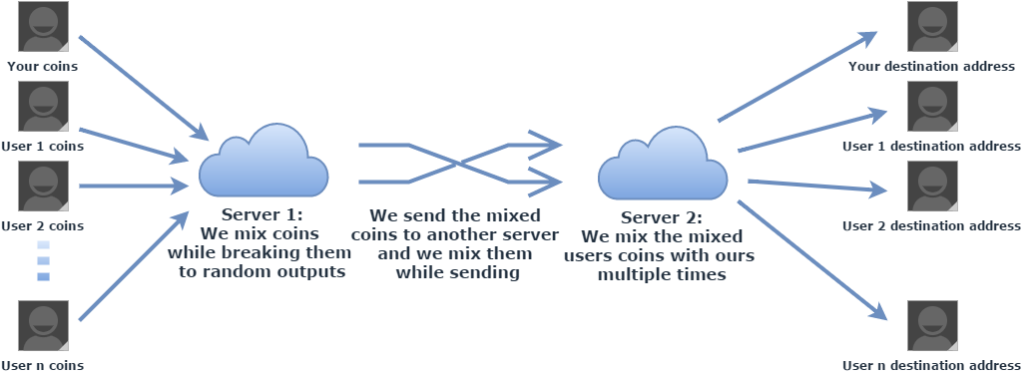
coin_mixing-04
How to thwart forensic investigation: Fogify explains an advanced mixing process

The next section of the article explains the danger of losing fungibility due to transaction tracing and blacklisting. I can see only ONE case for this, and it requires a consensus and a hard fork (preferably a consensus of ALL stakeholders and not just miners). For example, when a great number of Etherium was stolen during the DAO meltdown.

My partner, Manny Perez, and I take opposing views of blacklisting coins based on their ‘tainted’ history (according to “The Man”, of course!). I believe that blacklists must ultimately be rendered moot by ubiquitous mixing, random transaction-circuit delays, dilbert-060219and multiple-transaction ‘washing’ (intentionally invoking a term that legislators and forensic investigators hate)—Manny feels that there should be a “Law and Order” list of tainted coins. Last year, our Pro-&-Con views were published side-by-side in this whitepaper.
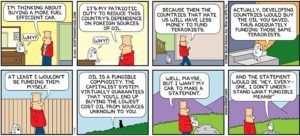
Finally, for Dogbert’s take on fungible, click here. I bought the domain fungible.net many years ago, and I still haven’t figured out what to do with it. Hence this Dilbert cartoon. smile
____________
Philip Raymond is co-chair of The Cryptocurrency Standards Association.
He also presents on privacy, anonymity, blind signaling & antiforensics.

How Smart Beta ETFs of the Future Will Use AI

Anyone who does not have QC as part of their 5+Yr Roadmap for IT are truly exposing their company as well as shareholders and customers. China, Russia, Cartels, DarkNet, etc. will use the technology to extort victims, destroy companies, economies, and complete countries where folks have not planned, budget, skilled up, and prep for full replacement of their infrastructure and Net access. Not to mention companies who have this infrastructure will provide better services/ CCE to svc. consumers.


In a recent article, we highlighted a smart beta ETF called the “Sprott BUZZ Social Media Insights ETF” that uses artificial intelligence (AI) to select and weight stocks. If we stop and think about that for a moment, that’s a pretty cool use of AI that seems well ahead of its time. Now we’re not saying that you should go out and buy this smart beta ETF right away. It uses social media data. We know that on social media, everyone’s an expert and many of the opinions that are stated are just that, opinions. However some of the signals may be legitimate. Someone who just bought Apple is likely to go on telling everyone how bullish they are on Apple shares. Bullish behavior is often accompanied by bullish rhetoric. And maybe that’s exactly the point, but the extent to which we’re actually using artificial intelligence here is not that meaningful. Simple scripting tools go out and scrape all this public data and then we use natural language processing (NLP) algorithms to determine if the data artifacts have a positive or negative sentiment. That’s not that intelligent, is it? This made us start to think about what it would take to create a truly “intelligent” smart beta ETF.

What is Smart Beta?

We have talked before about how people that work in finance love to obfuscate the simplicity of what they do with obscure acronyms and terminology. Complex nomenclature is suited for sophisticated scientific domains like synthetic biology or quantum computing but such language is hardly merited for use in the world of finance. We told you before what beta is. Smart beta is just another way of saying “rules based investing” which has in fact been around for centuries, but of course we act like it’s new and start publishing all kinds of research papers on it. In fact, a poll offered up by S&P Capital IQ shows that even 1 out of 4 finance professionals recognizes the term “smart beta” to be little more than a marketing gimmick:

How Economists View the Rise of Artificial Intelligence

Machine learning will drop the cost of making predictions, but raise the value of human judgement.

To really understand the impact of artificial intelligence in the modern world, it’s best to think beyond the mega-research projects like those that helped Google recognize cats in photos.

According to professor Ajay Agrawal of the University of Toronto, humanity should be pondering how the ability of cutting edge A.I. techniques like deep learning —which has boosted the ability for computers to recognize patterns in enormous loads of data—could reshape the global economy.

NASA Offers Prize Money for 3D-Printed Habitat Ideas

NASA is offering $1.1 million in prize money in Phase 2 of the 3D-Printed Habitat Challenge for new ways to build houses where future space explorers can live and work.

The three-part competition asks citizen inventors to use readily available and recyclable materials for the raw material to print habitats.

Phase 2 focuses on the material technologies needed to manufacture structural components from a combination of indigenous materials and recyclables, or indigenous materials alone. NASA may use these technologies to construct shelters for future human explorers to Mars. On Earth, these same capabilities could also be used to produce affordable housing wherever it is needed or where access to conventional building materials and skills is limited.

China Has Overtaken the U.S. In AI Research

In Brief:

  • The United States’ current levels of R&D spending on AI are one-half to one-quarter of the levels that would be best for economic growth.
  • Lagging behind in AI research could put the U.S. at a disadvantage if other countries get the opportunity to dictate how the technology is used.

The U.S. may be trailing behind China in artificial intelligence (AI) research — or at least in journal articles that mention “deep learning” or “deep neural network” — according to the White House’s National Artificial Intelligence Research and Development Strategic Plan.

Saudi Commentator Praises Israel; Latest Sign of Warming Ties Between Jewish and Arab States

Could technology build friendships for Israel across the Middle East?


Israel and Saudi Arabia should form a “collaborative alliance” to become the “twin pillars of regional stability” in the Middle East, a top Saudi lobbyist wrote in The Hill on Tuesday, in what is the latest sign of warming and increasingly-public ties between Arab countries and the Jewish state.

Salman al-Ansari, the founder and president of the Saudi American Public Relations Affairs Committee, asserted that Israel can assist Saudi Arabia in implementing its Vision 2030, the Kingdom’s blueprint to diversify its economy. Al-Ansari specifically mentioned Israel’s expertise in mining and water technology, which makes Israel “extraordinarily qualified to help Saudi Arabia with its ambitious desalination plans.”

Deputy Crown Prince Mohammed bin Salman, the man in charge of implementing Vision 2030, “is prepared and willing to develop real, enduring ties with Israel,” al-Ansari wrote, adding, “Any form of normalization between the two countries is also an Arabic and Muslim normalization towards Israel, which will undoubtedly promote security and weaken extremism in the region.”

/* */