Toggle light / dark theme

Massive 7.3 Tbps DDoS Attack Delivers 37.4 TB in 45 Seconds, Targeting Hosting Provider

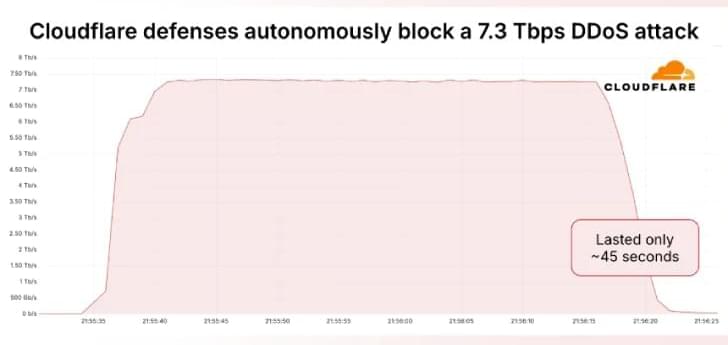
“Hosting providers and critical Internet infrastructure have increasingly become targets of DDoS attacks,” Cloudflare’s Omer Yoachimik said. “The 7.3 Tbps attack delivered 37.4 terabytes in 45 seconds.”

Earlier this January, the web infrastructure and security company said it had mitigated a 5.6 Tbps DDoS attack aimed at an unnamed internet service provider (ISP) from Eastern Asia. The attack originated from a Mirai-variant botnet in October 2024.

Then in April 2025, Cloudflare revealed it defended against a massive 6.5 Tbps flood that likely emanated from Eleven11bot, a botnet comprising roughly 30,000 webcams and video recorders. The hyper-volumetric attack lasted about 49 seconds.

New Android Malware Surge Hits Devices via Overlays, Virtualization Fraud, and NFC Theft

Cybersecurity researchers have exposed the inner workings of an Android malware called AntiDot that has compromised over 3,775 devices as part of 273 unique campaigns.

“Operated by the financially motivated threat actor LARVA-398, AntiDot is actively sold as a Malware-as-a-Service (MaaS) on underground forums and has been linked to a wide range of mobile campaigns,” PRODAFT said in a report shared with The Hacker News.

AntiDot is advertised as a “three-in-one” solution with capabilities to record the device screen by abusing Android’s accessibility services, intercept SMS messages, and extract sensitive data from third-party applications.

1,500+ Minecraft Players Infected by Java Malware Masquerading as Game Mods on GitHub

The campaign is suspected to be the work of a Russian-speaking threat actor owing to the presence of several artifacts written in the Russian language and the timezone of the attacker’s commits (UTC+03:00). It’s estimated that more than 1,500 devices may have fallen prey to the scheme.

“This case highlights how popular gaming communities can be exploited as effective vectors for malware distribution, emphasizing the importance of caution when downloading third-party content,” the researchers said.

“The Stargazers Ghost Network has been actively distributing this malware, targeting Minecraft players seeking mods to enhance their gameplay. What appeared to be harmless downloads were, in fact, Java-based loaders that deployed two additional stealers, capable of exfiltrating credentials and other sensitive data.”

Cloudflare blocks record 7.3 Tbps DDoS attack against hosting provider

Cloudflare says it mitigated a record-breaking distributed denial of service (DDoS) attack in May 2025 that peaked at 7.3 Tbps, targeting a hosting provider.

DDoS attacks flood targets with massive amounts of traffic with the sole aim to overwhelm servers and create service slowdowns, disruptions, or outages.

This new attack, which is 12% larger than the previous record, delivered a massive data volume of 37.4 TB in just 45 seconds. This is the equivalent of about 7,500 hours of HD streaming or 12,500,000 jpeg photos.

No, the 16 billion credentials leak is not a new data breach

News broke today about “one of the largest data breaches in history,” sparking wide media coverage filled with warnings and fear-mongering. However, it appears to just be a compilation of previously leaked credentials stolen by infostealers, exposed in data breaches, and via credential stuffing attacks.

To be clear, this is not a new data breach, or a breach at all, and the websites involved were not recently compromised to steal these credentials.

Instead, these stolen credentials were likely circulating for some time, if not for years. It was then collected by a cybersecurity firm, researchers, or threat actors and repackaged into a database that was exposed on the Internet.

Hackers could use smartwatches to eavesdrop on air-gapped computers via ultrasonic signals

A security specialist at Ben-Gurion University of the Negev has found evidence that it might be possible to infiltrate an air-gap computing system using a smartwatch. Mordechai Guri has published a paper outlining his ideas on the arXiv preprint server.

Air-gap computers or computing systems are those that have been physically removed from other networks, such as the internet, as a way to make them remotely hack-proof. The only way such a computer or system could be hacked would be to gain direct or to have someone do it for them. In his paper, Guri suggests there may be another way—by using features of smartwatches.

Smartwatches, Guri notes, have all the features needed to listen for ultrasonic signals from an air-gapped computer, starting with a microphone. They also could be used for processing signals or for routing them to a speaker or a Wi-Fi device, which could broadcast them to a more sophisticated device.

Zoomcar discloses security breach impacting 8.4 million users

Zoomcar Holdings (Zoomcar) has disclosed that unauthorized accessed its system led to a data breach impacting 8.4 million users.

The incident was detected on June 9, after a threat actor emailed company employees alerting them of a cyberattack.

Although there has been no material disruption to services, the company’s internal investigation confirmed that sensitive data belonging to a subset of its customers has been compromised.

/* */