If you like this video, check out Geraint Lewis´ excellent book, co-written with Chris Ferrie: Where Did the Universe Come From? And Other Cosmic Questions: Our Universe, from the Quantum to the Cosmos.
Puzzling ancient galaxies and oddly shaped clusters suggest we have glimpsed cosmic strings travelling at the speed of light – and with them clues to a deeper theory of reality.
Recent Gaia satellite findings suggest that dwarf galaxies are transient and less influenced by dark matter than previously believed, challenging long-held assumptions about their nature and composition.
Commonly thought to be long-lived satellites of our galaxy, a new study now finds indications that most dwarf galaxies might in fact be destroyed soon after their entry into the Galactic halo. Thanks to the latest catalog from ESA’s Gaia satellite, an international team has now demonstrated that dwarf galaxies might be out of equilibrium. The study opens important questions on the standard cosmological model, particularly on the prevalence of dark matter in our nearest environment.
It has long been assumed that the dwarf galaxies around the Milky Way are ancient satellites orbiting our Galaxy for nearly 10 billion years. This required them to contain huge amounts of dark matter to protect them from the enormous tidal effects due to the gravitational pull of our galaxy. It was assumed that dark matter caused the large differences observed in the velocities of the stars within these dwarf galaxies.
Sign Up on Patreon to get access to the Space Time Discord! / pbsspacetime.
If we ever want to simulate a universe, we should probably learn to simulate even a single atomic nucleus. But it’s taken some of the most incredible ingenuity of the past half-century to figure out how that out. All so that today I can teach you how to simulate a very very small universe.
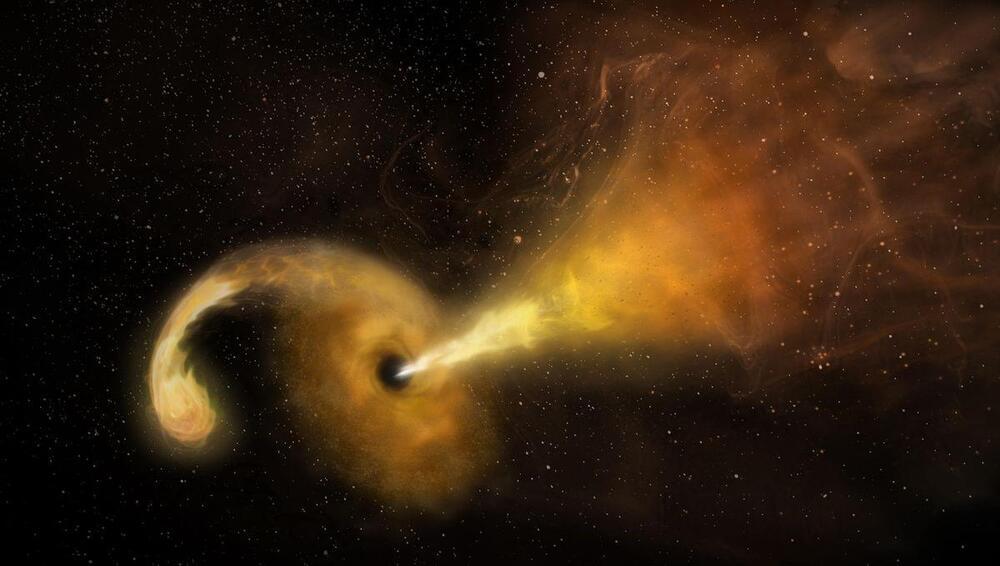
Black holes are some of the most powerful objects in the universe — and humans could devise ways to harness that power as an energy source, a new theoretical study claims.
A recent study published in the journal Physical Review D marks a significant advancement in cosmology. A team of researchers has analyzed over one million galaxies to delve into the origins of the universe’s current cosmic structures.
This study contributes to the understanding of the ΛCDM model, the standard framework for the universe, which posits the significance of cold dark matter (CDM) and dark energy (the cosmological constant, Λ).
The model theorizes that primordial fluctuations, originating at the universe’s inception, acted as catalysts for the formation of all celestial objects, including stars, galaxies, and galaxy clusters.