Toggle light / dark theme

New study challenges Einstein and Newton’s theories of gravity

No, it’s not dark matter.

Gravity is the force that attracts objects toward the Earth and maintains the orbital motion of planets around the Sun. Our scientific understanding of gravity was established by Isaac Newton.

Despite the many successes of Einstein’s theory of gravity, many phenomena, such as gravity inside a black hole and gravitational waves, can’t be explained.


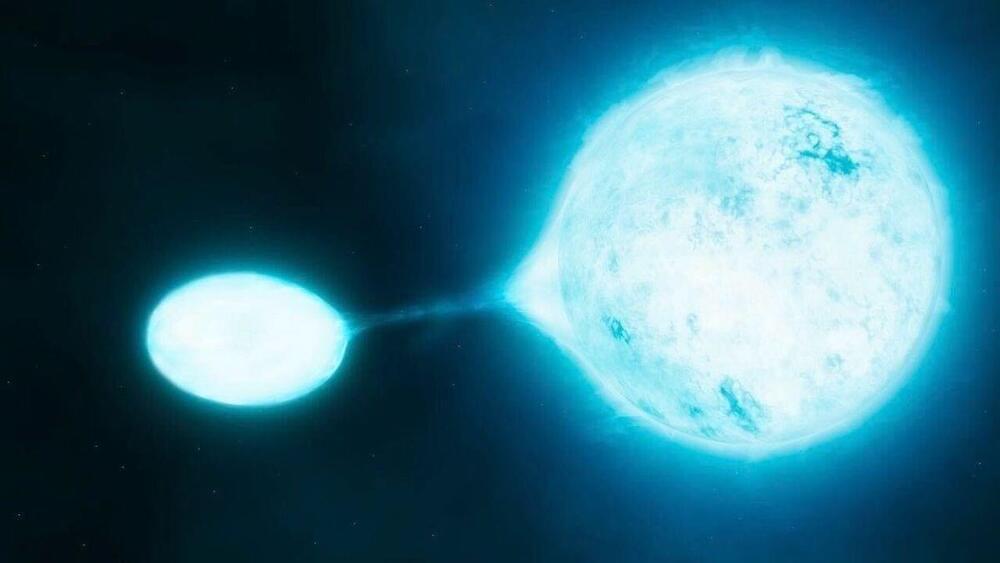
Tod Strohmayer (GSFC), CXC, NASA — Illustration: Dana Berry (CXC)

Our scientific understanding of gravity was established by Isaac Newton in 1687. Newton’s theory of gravity stood the test of time for two centuries until Albert Einstein proposed his ‘General Theory of Relativity,’ filling in the gaps left by Newton’s theory of gravity.
Did JWST Discover Dark Matter Stars?

Check Out Human Footprint on PBS Terra: https://youtu.be/-c_KBWyPGaQ

PBS Member Stations rely on viewers like you. To support your local station, go to: http://to.pbs.org/DonateSPACE

Sign Up on Patreon to get access to the Space Time Discord!
https://www.patreon.com/pbsspacetime.

We knew that the James Webb Space Telescope would find interesting stuff, especially about the mysterious early times. For example, there are hints that the galaxies we’re seeing are brighter and more regular than expected given the short amount of time they’d had to grow. Well, perhaps no one was expecting that we’d find a completely new type of star—one mostly made of and powered by dark matter and shining as bright as an entire galaxy. Which, by the way, might help us explain those pesky giant galaxies.

Check out the Space Time Merch Store.
https://www.pbsspacetime.com/shop.

Sign up for the mailing list to get episode notifications and hear special announcements!

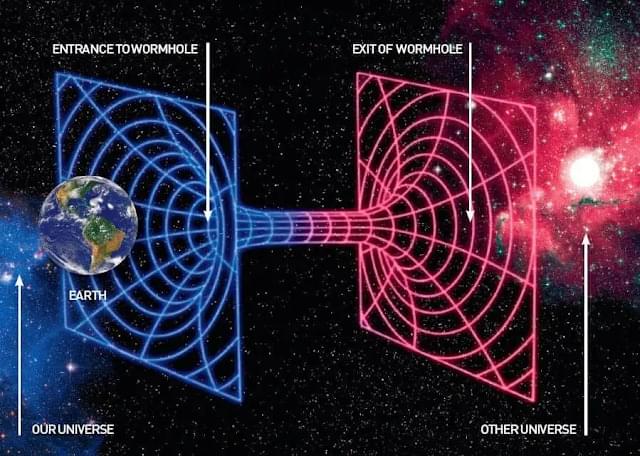
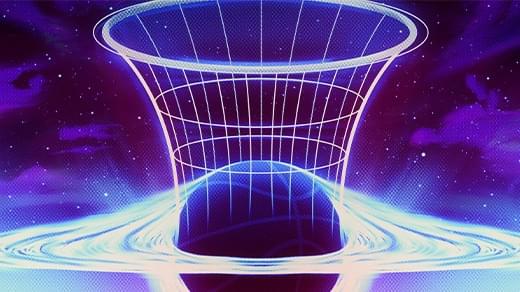
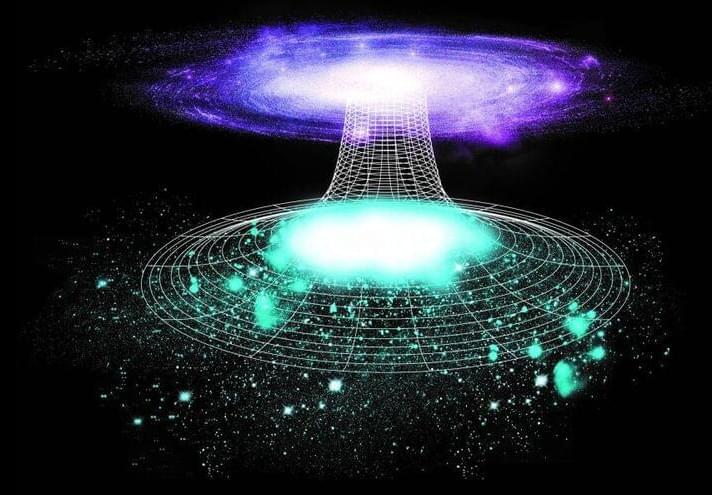
Could white holes actually exist?

Black holes seem to get all the attention. But what about their mirror twins, white holes? Do they exist? And, if so, where are they?

To understand the nature of white holes, first we have to examine the much more familiar black holes. Black holes are regions of complete gravitational collapse, where gravity has overwhelmed all other forces in the universe and compressed a clump of material all the way down to an infinitely tiny point known as a singularity. Surrounding that singularity is an event horizon, which is not a physical, solid boundary, but simply the border around a singularity where the gravity is so strong that nothing, not even light, can escape.

Can we understand the universe? | Sheldrake & Hossenfelder go head to head on dark matter IN FULL

Sabine Hossenfelder, Rupert Sheldrake and Bjorn Ekeberg go head to head on consciousness, panpsychism, physics and dard matter.

Watch more fiery contenet at https://iai.tv?utm_source=YouTube&utm_medium=description&utm…e-universe.

“Not only is the universe stranger than we think. It is stranger than we can think.” So argued Niels Bohr, one of the founders of quantum theory. We imagine our theories uncover how things are but, from quantum particles to dark matter, at fundamental levels the closer we get to what we imagine to be reality the stranger and more incomprehensible it appears to become.

Might science, and philosophy one day stretch to meet the universe’s strangeness? Or is the universe not so strange after all? Or should we give up the idea that we can uncover the essential character of the world, and with Bohr conclude that the strangeness of the universe and the quantum world transcend the limits of the human mind?

#DarkMatter #RupertSheldrake #SabineHossenfelder.

Influential scientist Rupert Sheldrake, prominent physicist Sabine Hossenfelder and esteemed philosopher Bjørn Ekeberg get to grips with whether the universe is stranger than we can imagine. Johnjoe McFadden hosts.

A quantum leap in mechanical oscillator technology

Over the past decade, scientists have made tremendous progress in generating quantum phenomena in mechanical systems. What seemed impossible only fifteen years ago has now become a reality, as researchers successfully create quantum states in macroscopic mechanical objects.

By coupling these mechanical oscillators to light photons—known as “optomechanical systems”—scientists have been able to cool them down to their lowest energy level close to the , “squeeze them” to reduce their vibrations even further, and entangle them with each other. These advancements have opened up new opportunities in , compact storage in quantum computing, fundamental tests of quantum gravity, and even in the search for dark matter.

In order to efficiently operate optomechanical systems in the quantum regime, scientists face a dilemma. On one hand, the mechanical oscillators must be properly isolated from their environment to minimize ; on the other hand, they must be well-coupled to other such as electromagnetic resonators to control them.

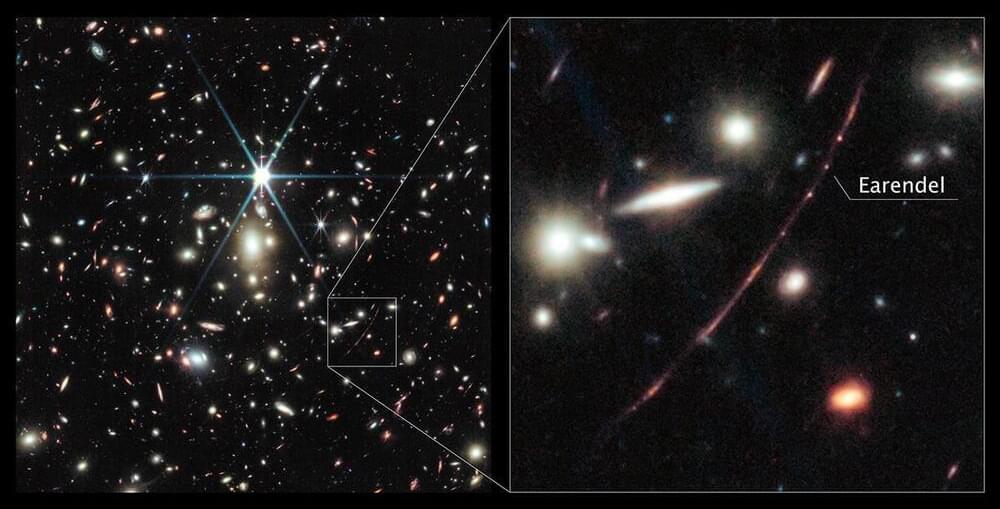
Webb reveals colors, features of most distant star ever detected

Webb’s NIRCam (Near-Infrared Camera) instrument reveals the star, nicknamed Earendel, to be a massive B-type star more than twice as hot as our sun, and about a million times more luminous. (Image: NASA, ESA, CSA, D. Coe (STScI/AURA for ESA; Johns Hopkins University), B. Welch (NASA’s Goddard Space Flight Center; University of Maryland, College Park). Image processing: Z. Levay.)

The star in the very distant universe, and a billion years after the big bang, was captured by the observatory’s Near-InfraRed Camera instrument.

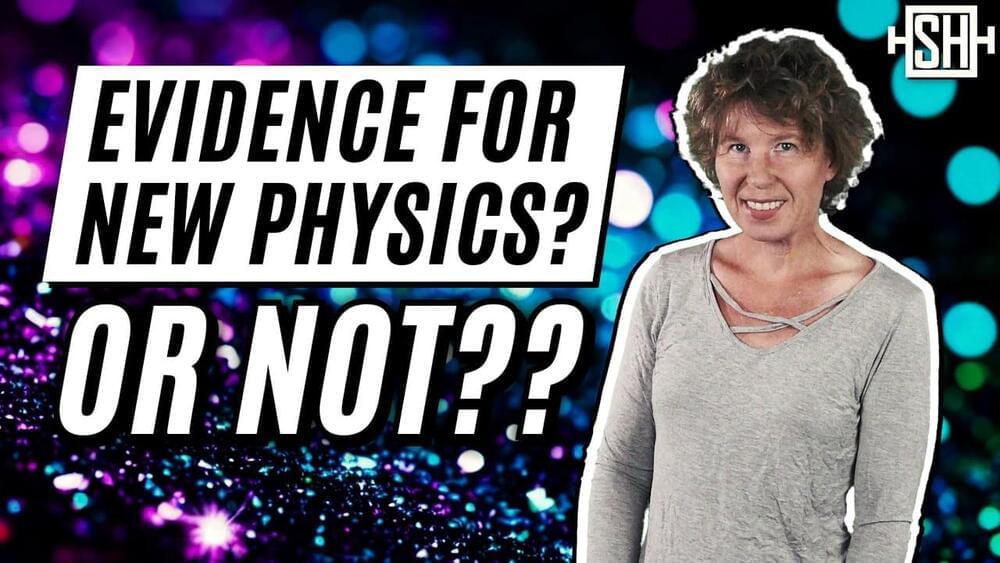
New physics or not? I’ll sort it out for you

All this and stamp collecting?paraphrase Lord Kelvin.


If you’d like to learn more about quantum mechanics, use our link https://brilliant.org/sabine — You can get started for free, and the first 200 will get 20% off the annual premium subscription.

Correction to what I say at 14:22 — The KATRIN experiment does not look for neutrinoless double beta decay, it’s trying to measure the absolute neutrino masses. There are several other experiments looking for neutrinoless double beta decay. Sorry about that mixup!

Some physicists are claiming that there is something “wrong” with our understanding of the universe. Oftentimes, it’s just to justify asking for funding for new experiments, a better detector, a new telescope, a bigger collider, but what if there’s something more than that? Do we have evidence of new physics? Or not? In this video, we will look at dark matter and dark energy, quantum gravity, the mass of the Higgs-boson, neutrino masses, and the matter-antimatter asymmetry.

💌 Support us on Donatebox ➜ https://donorbox.org/swtg.

/* */