String theory is widely considered beyond empirical investigation. But we could conceivably test it thanks to ancient particles called moduli, which might appear in astronomical observations, says theorist Joseph Conlon.

String theory is widely considered beyond empirical investigation. But we could conceivably test it thanks to ancient particles called moduli, which might appear in astronomical observations, says theorist Joseph Conlon.
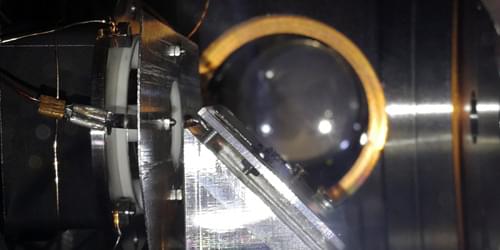
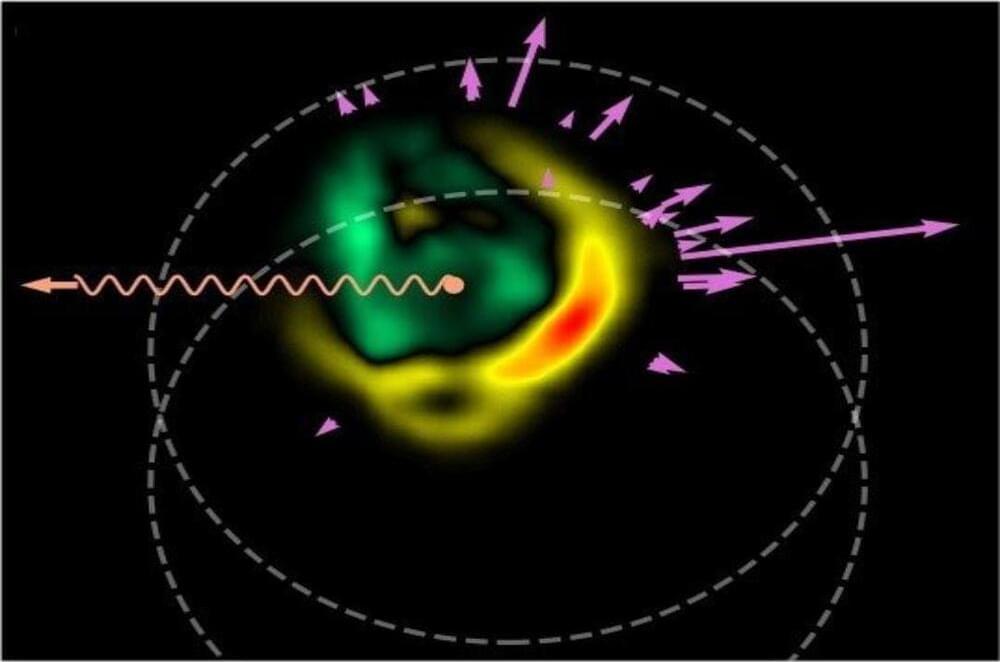
The goal of the AEgIS Collaboration at CERN in Switzerland is to measure the effect of Earth’s gravitational field on antimatter—specifically, antihydrogen atoms. Antihydrogen is produced using positronium—which consists of an electron and a positron bound together—and the colder the positronium, the faster the antihydrogen production rate. Accordingly, AEgIS researchers have spent the past four years trying to develop a way to cool positronium. Now, with their first demonstration of positronium laser cooling, they have succeeded [1].
Laser-cooling positronium is a much tougher undertaking than laser-cooling regular atoms. Positronium can only survive for 140 nanoseconds before annihilating, even in ultrahigh vacuum. Moreover, the relevant transition frequency for positronium cooling is in the deep ultraviolet, where laser technology remains relatively undeveloped.
The AEgIS Collaboration designed a custom laser system that uses the mineral alexandrite as the lasing medium. Alexandrite-based lasers emit at deep-ultraviolet wavelengths, but devices that meet the intensity and pulse-length requirements for positronium cooling are not commercially available. The researchers also had to overcome another major hurdle: to avoid the loss of positronium atoms during the cooling process, any external electric and magnetic fields had to be eliminated. As a result, the electrostatic equipment used for manipulating the positronium had to be capable of being switched off in a matter of nanoseconds.
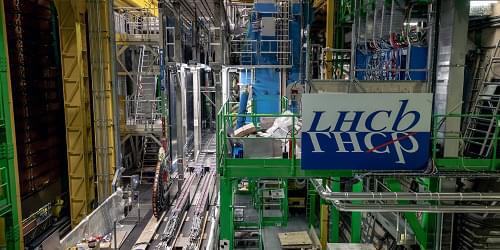
AEgIS is one of several experiments at CERN’s Antimatter Factory producing and studying antihydrogen atoms with the goal of testing with high precision whether antimatter and matter fall to Earth in the same way.
In a paper published today in Physical Review Letters, the AEgIS collaboration reports an experimental feat that will not only help it achieve this goal but also pave the way for a whole new set of antimatter studies, including the prospect to produce a gamma-ray laser that would allow researchers to look inside the atomic nucleus and have applications beyond physics.
To create antihydrogen (a positron orbiting an antiproton), AEgIS directs a beam of positronium (an electron orbiting a positron) into a cloud of antiprotons produced and slowed down in the Antimatter Factory. When an antiproton and positronium meet in the antiproton cloud, the positronium gives up its position to the antiproton, forming an antihydrogen.

The U.S. Naval Research Laboratory (NRL), working together with Kansas State University, has announced the discovery of slab waveguides made from the two-dimensional material hexagonal boron nitride. This milestone has been documented in the journal Advanced Materials.
Two-dimensional (2D) materials are a class of materials that can be reduced to the monolayer limit by mechanically peeling the layers apart. The weak interlayer attractions, or van der Waals attraction, allows the layers to be separated via the so-called “Scotch tape” method. The most famous 2D material, graphene, is a semimetallic material consisting of a single layer of carbon atoms. Recently, other 2D materials including semiconducting transition metal dichalcogenides (TMDs) and insulating hexagonal boron nitride (hBN) have also garnered attention. When reduced near the monolayer limit, 2D materials have unique nanoscale properties that are appealing for creating atomically thin electronic and optical devices.

An international team of scientists has made a new discovery that may help to unlock the microscopic mystery of high-temperature superconductivity and address the world’s energy problems.
In a paper published in the journal Nature, Swinburne University of Technology’s Associate Professor Hui Hu collaborated with researchers at the University of Science and Technology of China (USTC) in a new experimental observation quantifying the pseudogap pairing in a strongly attractive interacting cloud of fermionic lithium atoms.
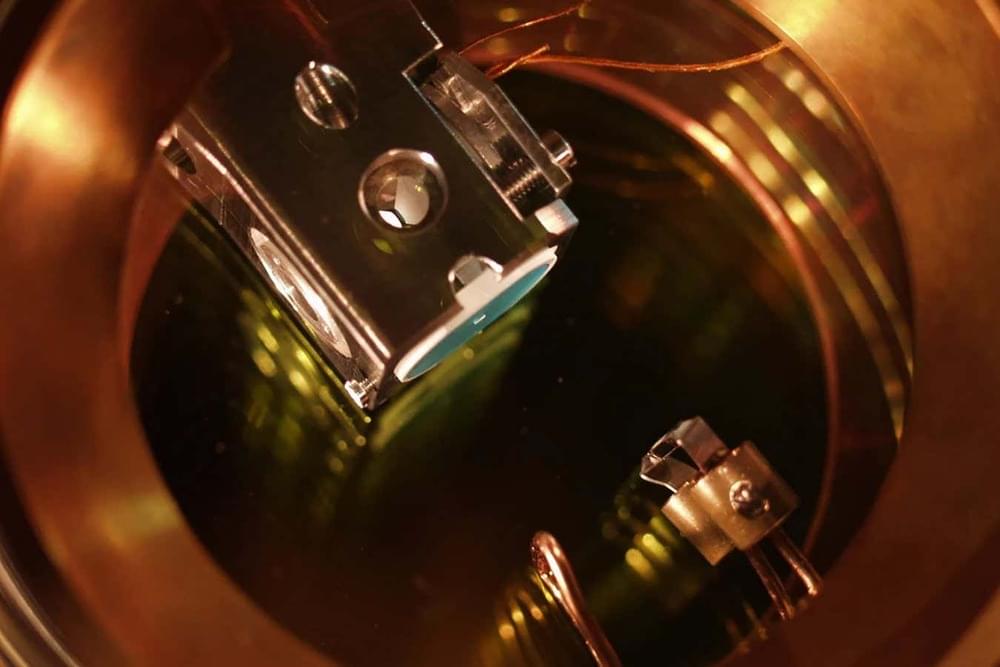
In a quantum engine, a single atom can emit radiation that bounces around a reflective cavity and creates enough pressure to push down a piston.
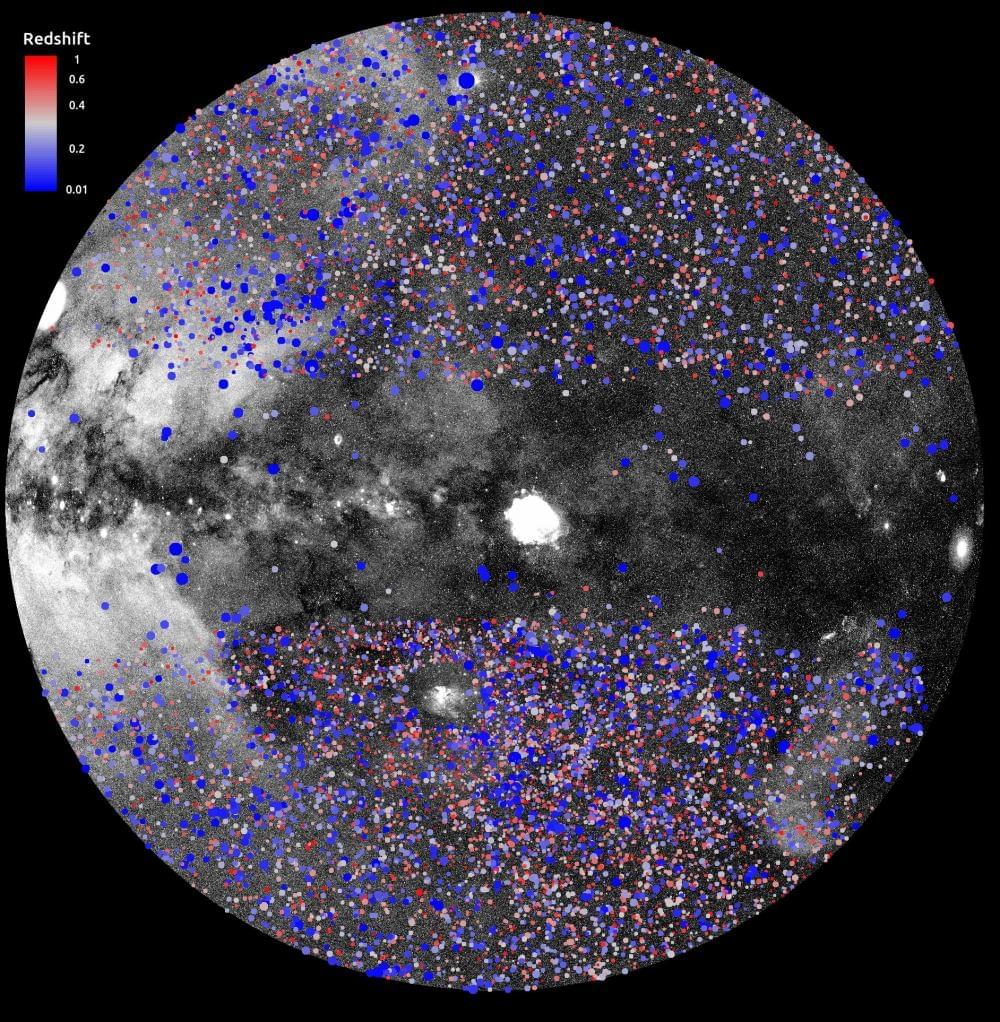
Cosmologists are wrestling with an interesting question: how much clumpiness does the Universe have? There are competing but not compatible measurements of cosmic clumpiness and that introduces a “tension” between the differing measurements. It involves the amount and distribution of matter in the Universe. However, dark energy and neutrinos are also in the mix. Now, results from a recent large X-ray survey of galaxy clusters may help “ease the tension”
The eROSITA X-ray instrument orbiting beyond Earth performed an extensive sky survey of galaxy clusters to measure matter distribution (clumpiness) in the Universe. Scientists at the Max Planck Institute for Extraterrestrial Physics recently shared their analysis of its cosmologically important data.
“eROSITA has now brought cluster evolution measurement as a tool for precision cosmology to the next level,” said Dr. Esra Bulbul (MPE), the lead scientist for eROSITA’s clusters and cosmology team. “The cosmological parameters that we measure from galaxy clusters are consistent with state-of-the-art cosmic microwave background, showing that the same cosmological model holds from soon after the Big Bang to today.”
Neutron stars in the universe, ultracold atomic gases in the laboratory, and the quark–gluon plasma created in collisions of atomic nuclei at the Large Hadron Collider (LHC): they may seem totally unrelated but, surprisingly enough, they have something in common.
They are all a fluid-like state of matter made up of strongly interacting particles. Insights into the properties and behavior of any of these almost-perfect liquids may be key to understanding nature across scales that are orders of magnitude apart.
In a new paper, the CMS collaboration reports the most precise measurement to date of the speed at which sound travels in the quark–gluon plasma, offering new insights into this extremely hot state of matter.
The Large Hadron Collider hasn’t seen any new particles since the discovery of the Higgs boson in 2012. Here’s what researchers are trying to do about it.