Researchers paint a grim picture of a corporate mind-melding future via brain-computer interface technology that’s as addictive as opioids.
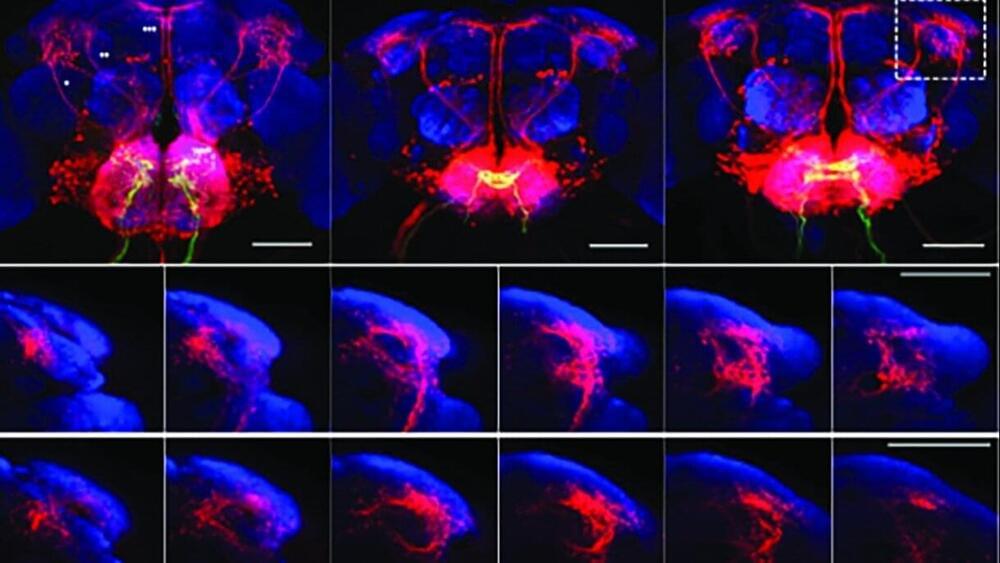
The findings, published in Nature Communications, could have important implications for human health: minis have been found at every type of synapse studied so far, and defects in miniature neurotransmission have been linked to range of neurodevelopmental disorders in children. Figuring out how a reduction in miniature neurotransmission changes the structure of synapses, and how that in turn affects behavior, could help to better understand neurodegenerative disorders and other brain conditions.
Summary: Study reveals how miniature release events help to keep neurons intact and preserve motor neuron function in aging insects.
Source: EPFL
Neurons communicate through rapid electrical signals that regulate the release of neurotransmitters, the brain’s chemical messengers. Once transmitted across a neuron, electrical signals cause the juncture with another neuron, known as a synapse, to release droplets filled with neurotransmitters that pass the information on to the next neuron. This type of neuron-to-neuron communication is known as evoked neurotransmission.
However, some neurotransmitter-packed droplets are released at the synapse even in the absence of electrical impulses. These miniature release events — or minis — have long been regarded as ‘background noise’, says Brian McCabe, Director of the Laboratory of Neural Genetics and Disease and a Professor in the EPFL Brain Mind Institute.
Researchers warn of the potential social, ethical, and legal consequences of technologies interacting heavily with human brains.
Surpassing the biological limitations of the brain and using one’s mind to interact with and control external electronic devices may sound like the distant cyborg future, but it could come sooner than we think.
Researchers from Imperial College London conducted a review of modern commercial brain-computer interface (BCI) devices, and they discuss the primary technological limitations and humanitarian concerns of these devices in APL Bioengineering, from AIP Publishing.
Replacing Aging — Dr. Jean M. Hebert, Ph.D. Albert Einstein College of Medicine.
Dr. Jean M. Hebert, Ph.D. (https://einsteinmed.org/faculty/9069/jean-hebert/) is Professor in the Department of Genetics and in the Dominick P. Purpura Department of Neuroscience, at Albert Einstein College of Medicine.
He’s also the author of the book Replacing Aging, which describes how regenerative medicine will beat aging.
With a Ph.D. in Genetics from the University of California, San Francisco, Dr. Hebert’s current lab’s projects fall into two groups.
First, they focus on using the mouse neocortex as a platform for testing the ability of multi-cell type grafts (increasingly resembling normal neocortex) to integrate with host tissue.
Solid state batteries are the long-promised Holy Grail of battery technology. They’re smaller and better than existing Lithium Ion batteries. They charge more quickly and last much longer. What’s not to like? Trouble is, no-one’s managed to mass produce one at any useful scale yet. Turns out it’s quite tricky to make them reliable! Now though, two major Japanese companies are finally firing up their full production lines. So will 2021 be the year?
Video Transcripts available at our website.
http://www.justhaveathink.com.
Help support this channels independence at http://www.patreon.com/justhaveathink.
Or with a donation via Paypal by clicking here.
https://www.paypal.com/cgi-bin/webscr?cmd=_s-xclick&hosted_b…source=url.
You can also help keep my brain ticking over during the long hours of research and editing via the nice folks at BuyMeACoffee.com.
https://www.buymeacoffee.com/justhaveathink.
Download the Just Have a Think App from the AppStore or Google Play.
Summary: Newly synthesized compounds can halt the degradation of neurons in a range of neurodegenerative diseases, including Alzheimer’s and Parkinson’s disease, researchers say.
Source: Ural Federal University
Russian scientists have synthesized chemical compounds that can stop the degeneration of neurons in Alzheimer’s, Parkinson’s, and other severe brain pathologies. These substances can provide a breakthrough in the treatment of neurodegenerative pathologies.
New molecules of pyrrolyl-and indolylazine classes activate intracellular mechanisms to combat one of the main causes of “aged” brain diseases – an excess of so-called amyloid structures that accumulate in the human brain with age.
“In this study, for the first time, we see evidence that events which were always assumed to be occurring in the same manner, regardless of sex, may actually be completely different in males compared to females. The fact that these differences involve astrocytes, which have traditionally been ignored in neuroscience but have recently become a hot topic for study, makes them all the more intriguing.”
Summary: Thrombospondin-2, a protein with cell adhesion properties usually secreted by astrocytes, prompted a strong increase in synapses in male-derived neurons but showed no effect in females.
Source: Marshall University
During development, brain cells may find different ways to connect with each other based on sex, according to researchers at the Marshall University Joan C. Edwards School of Medicine.
The study, recently published in eNeuro, showed a significantly more robust synaptogenic response in male-derived cells compared to female-derived cells when exposed to factors secreted from astrocytes, which are non-neuronal cells found throughout the central nervous system.
Summary: A newly developed questionnaire can detect autism in children between the ages of 18 to 30 months.
Source: University of Cambridge.
New research led by the University of Cambridge suggests that autism can be detected at 18–30 months using the Quantitative Checklist for Autism in Toddlers (Q-CHAT), but it is not possible to identify every child at a young age who will later be diagnosed as autistic.
One of the most important open questions in science is how our consciousness is established. In the 1990s, long before winning the 2020 Nobel Prize in Physics for his prediction of black holes, physicist Roger Penrose teamed up with anaesthesiologist Stuart Hameroff to propose an ambitious answer.
They claimed that the brain’s neuronal system forms an intricate network and that the consciousness this produces should obey the rules of quantum mechanics – the theory that determines how tiny particles like electrons move around. This, they argue, could explain the mysterious complexity of human consciousness.
Penrose and Hameroff were met with incredulity. Quantum mechanical laws are usually only found to apply at very low temperatures. Quantum computers, for example, currently operate at around -272°C. At higher temperatures, classical mechanics takes over. Since our body works at room temperature, you would expect it to be governed by the classical laws of physics. For this reason, the quantum consciousness theory has been dismissed outright by many scientists – though others are persuaded supporters.
New research from the RIKEN Center for Brain Science (CBS) in Japan shows that a deficit in histone methylation could lead to the development of autism spectrum disorders (ASD). A human variant of the SUV39H2 gene led researchers to examine its absence in mice. Published in Molecular Psychiatry, the study found that when absent, adult mice exhibited cognitive inflexibility similar to what occurs in autism, and embryonic mice showed misregulated expression of genes related to brain development. These findings represent the first direct link between the SUV39H2 gene and ASD.
Genes are turned on and off throughout our development. But genetic variation means that what is turned off in some people remains turned on in others. This is why, for example, some adults can digest dairy products and others are lactose intolerant; the gene for making the enzyme lactase is turned off when some people become adults, but not others. One way that genes can be turned on and off is through a process called histone methylation in which special enzymes transfer methyl groups to histone proteins that are wrapped around DNA.
Variations in genes related to methylation during brain development can lead to serious problems. One such variation occurs in a rare disorder called Kleefstra Syndrome, in which a mutation prevents methylation of H3K9—a specific location on histone H3. Because Kleefstra Syndrome resembles autism in some ways, RIKEN CBS researchers led by Takeo Yoshikawa looked for autism-specific variations in genes that can modify H3K9. Among nine such genes, they found one variant in an H3K9 methyltransferase gene— SUV39H2 —that was present in autism, and the mutated SUV39H2 prevented methylation when tested in the lab. Similar loss-of-function results were found for the mouse version of the variant.