Circa 2017
One of the options that the United States is looking at to counter North Korea’s nuclear-tipped ballistic missiles is an experimental weapon called CHAMP.

Circa 2017
One of the options that the United States is looking at to counter North Korea’s nuclear-tipped ballistic missiles is an experimental weapon called CHAMP.

In 1948 Frank Wisner was appointed director of the Office of Special Projects. Soon afterwards it was renamed the Office of Policy Coordination (OPC). This became the espionage and counter-intelligence branch of the Central Intelligence Agency. Wisner was told to create an organization that concentrated on “propaganda, economic warfare; preventive direct action, including sabotage, anti-sabotage, demolition and evacuation measures; subversion against hostile states, including assistance to underground resistance groups, and support of indigenous anti-Communist elements in threatened countries of the free world.”
Later that year Wisner established Mockingbird, a program to influence the domestic American media. Wisner recruited Philip Graham (Washington Post) to run the project within the industry. Graham himself recruited others who had worked for military intelligence during the war. This included James Truitt, Russell Wiggins, Phil Geyelin, John Hayes and Alan Barth. Others like Stewart Alsop, Joseph Alsop and James Reston, were recruited from within the Georgetown Set. According to Deborah Davis, the author of Katharine the Great (1979) : “By the early 1950s, Wisner ‘owned’ respected members of the New York Times, Newsweek, CBS and other communications vehicles.”
In 1951 Allen W. Dulles persuaded Cord Meyer to join the CIA. However, there is evidence that he was recruited several years earlier and had been spying on the liberal organizations he had been a member of in the later 1940s. According to Deborah Davis, Meyer became Mockingbird’s “principal operative”.

Thanks to the Contingency Operations program, the military is able to utilize the first GPS III satellite without the next-generation ground segment being built for it. The second GPS III satellite was launched in April, and a third launch is slated for later this year. (Airman 1st Class Dalton Williams/Air Force)
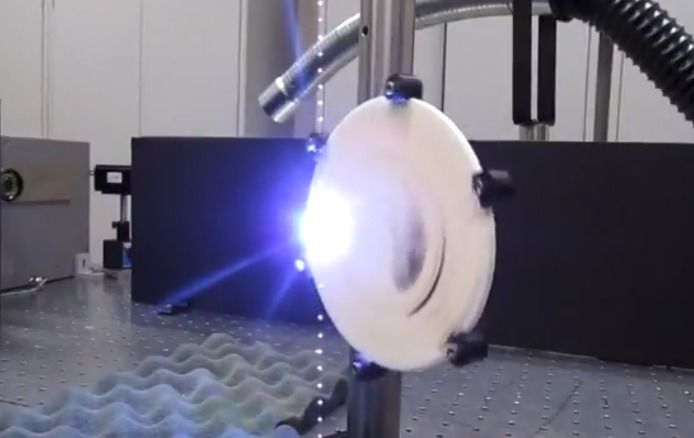

Researchers have developed a new way to use lasers to see around corners that beats the previous technique on resolution and scanning speed. The U.S. military is interested for obvious reasons, and NASA wants to use it to image caves. The technique might one day also let rescue workers peer into earthquake-damaged buildings and help self-driving cars navigate tricky intersections.
Researchers from Rice, Stanford, Princeton, and Southern Methodist University have developed a new way to use lasers to see around corners that beats the previous technique on resolution and scanning speed. The findings appear today in the journal Optica.
The U.S. military—which funded the work through DARPA grants—is interested for obvious reasons, and NASA wants to use it to image caves, perhaps doing so from orbit. The technique might one day also let rescue workers peer into earthquake-damaged buildings and help self-driving cars navigate tricky intersections.
One day. Right now it’s a science project, and any application is years away.
As the U.S. Army increasingly uses facial and object recognition to train artificial intelligent systems to identify threats, the need to protect its systems from cyberattacks becomes essential.
An Army project conducted by researchers at Duke University and led by electrical and computer engineering faculty members Dr. Helen Li and Dr. Yiran Chen, made significant progress toward mitigating these types of attacks. Two members of the Duke team, Yukun Yang and Ximing Qiao, recently took first prize in the Defense category of the CSAW ‘19 HackML competition.
“Object recognition is a key component of future intelligent systems, and the Army must safeguard these systems from cyberattacks,” said MaryAnne Fields, program manager for intelligent systems at the Army Research Office. “This work will lay the foundations for recognizing and mitigating backdoor attacks in which the data used to train the object recognition system is subtly altered to give incorrect answers. Safeguarding object recognition systems will ensure that future Soldiers will have confidence in the intelligent systems they use.”

I experienced these creatures in my town they did not corporealize but as a psychic I can feel them and when you see irregular fog that moves like a wall or with fingers be careful as like I believe these creatures exist.
The creatures of the Mist are the inhabitants of an alternate reality. After a severe rainstorm from the night before, a thick, foggy, unusual mist crept into our world, bringing the creatures with it when a top secret government experiment involving many scientists called the “Arrowhead Project”, intended to peer into other dimensions, went terribly wrong. This allowed the creatures to cross over the spilled portal and into the human realm. The phenomenon first manifested in Bridgton, Maine, and spread across an unknown amount of the U.S., or possibly the entire planet. Due to the thickness of the mist making sight almost useless to them, all the creatures in the mist hunt on the basis of scent. In the novella by Stephen King, it is hinted that the mist plagued the entire world and thus the creatures nearly eliminated humanity; while in the film version, the creatures were only seen in a certain area of America and were exterminated by the military two or three days after the Arrowhead Project went wrong.
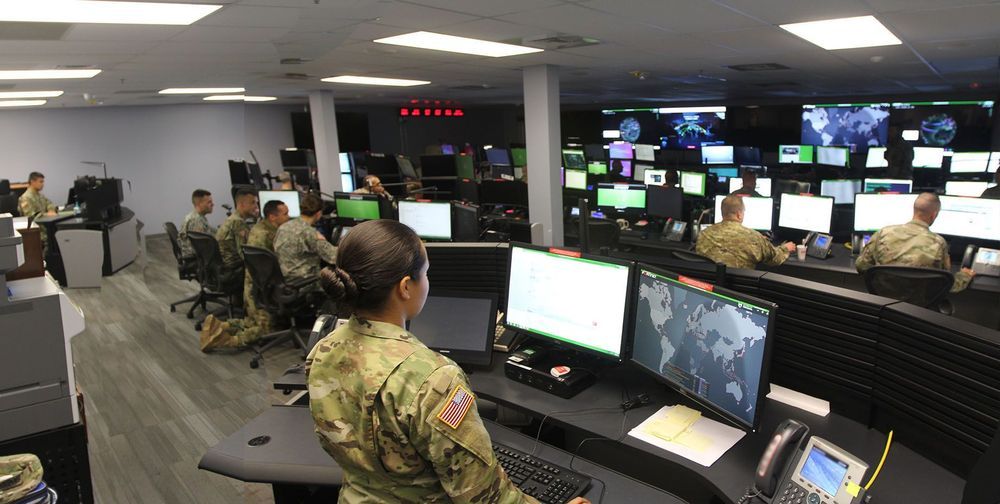
As warfare continues to enter the digital realm, the Army plans to transform its cyber operations branch into a full-scale information warfare command, according to a top U.S. general.
The service will convert Cyber Command into the Army Information Warfare Command, Army Chief of Staff Gen. James McConville said at a panel on Tuesday. It’s one of the several modernization efforts the Army is taking on to counter “great power” opponents like Russia and China.
“We’re recognizing the importance of information operations, so our Cyber Command is going to become an information warfare command,” McConville said.