AR-Smart glasses: 2029. Will look like just a normal pair of sunglasses. All normal smartphone type features. Built in AI systems. Set up for some VR stuff. An built in earbud / mic, for calls, music, talking to Ai, etc… May need a battery pack, we ll see in 2029.
The smart glasses will soon come with a built-in assistant.
To what extent are exceptional human achievements influenced by genetic factors? This question, dating back to the early days of human genetics, seems to be easier to address today as modern molecular methods make it possible to analyze DNA of individuals throughout history. But how reliable are the answers in this day and age?
Summary: Recent research reveals that individuals with Borderline Personality Disorder (BPD) exhibit distinct music preferences, favoring reflective and complex genres such as classical and jazz over intense, rebellious ones.
The study, involving 549 participants, highlights how the severity of BPD symptoms influences these preferences and the psychological functions of music, emphasizing its role in emotional regulation and social connectivity.
Music’s functions act as mediators in forming these preferences, suggesting that musical tastes among individuals with BPD reflect their internal psychological needs. This insight opens new avenues for tailored music therapy interventions, promising more effective therapeutic outcomes.
Research conducted by Brown University’s Carney Institute for Brain Science illustrates how parts of the brain need to work together to focus on important information while filtering out distractions.
Imagine a busy restaurant: dishes clattering, music playing, people talking loudly over one another. It’s a wonder that anyone in that kind of environment can focus enough to have a conversation. A new study by researchers at Brown University’s Carney Institute for Brain Science provides some of the most detailed insights yet into the brain mechanisms that help people pay attention amid such distraction, as well as what’s happening when they can’t focus.
In an earlier psychology study, the researchers established that people can separately control how much they focus (by enhancing relevant information) and how much they filter (by tuning out distractions). The team’s new research, published in Nature Human Behaviour, unveils the process by which the brain coordinates these two critical functions.
Ìsaac asimov in his classic science for the layman book on neuroscience the human brain made an interesting speculation of whether or not the brain could understand itself he speculated if the brain could learn enough about its own functions the phenomenon of creativity and imagination and intuition…
Use code isaacarthur at the link below to get an exclusive 60% off an annual Incogni plan: https://incogni.com/isaacarthur. Life is incredibly complicated, but for most of Earth’s history it was much simpler. Is it possible the Universe is full of planets with very simple life, and complex organisms are rare?
Whether in listening to music or pushing a swing in the playground, we are all familiar with resonances and how they amplify an effect—a sound or a movement, for example. However, in high-intensity circular particle accelerators, resonances can be an inconvenience, causing particles to fly off their course and resulting in beam loss. Predicting how resonances and non-linear phenomena affect particle beams requires some very complex dynamics to be disentangled.
🔺Prepare to be transported to another world with the most epic and breathtaking ambient sci-fi music you haven’t heard yet! I’ve spent over 20 hours \.
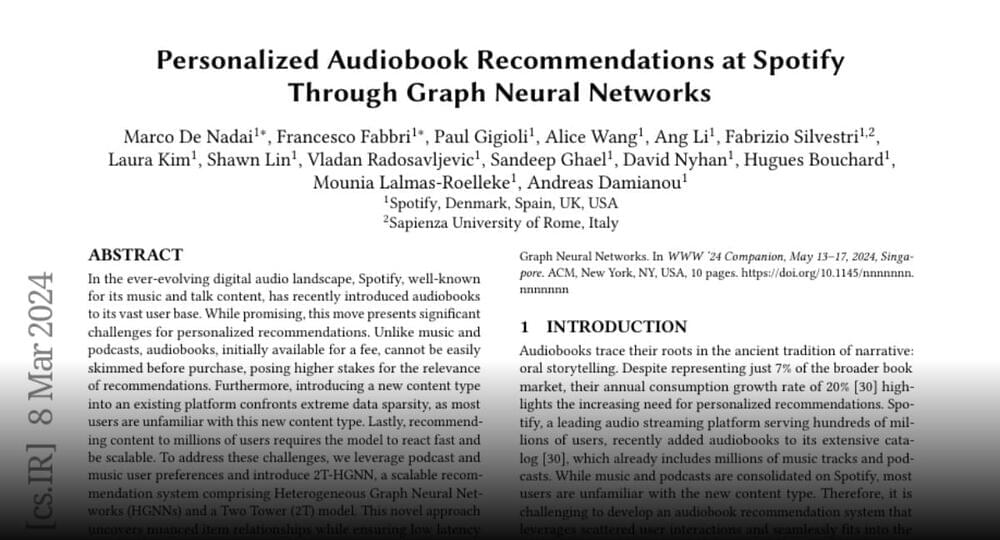
Spotify presents Personalized Audiobook Recommendations at Spotify Through Graph Neural Networks.
In the ever-evolving digital audio landscape, Spotify, well-known for its music and talk content, has recently introduced audiobooks to its vast user base.
The film industry, always at the forefront of technological innovation, is increasingly embracing artificial intelligence (AI) to revolutionize movie production, distribution, and marketing. From script analysis to post-production, Already AI is reshaping how movies are made and consumed. Let’s explore the current applications of AI in movie studios and speculates on future uses, highlighting real examples and the transformative impact of these technologies.
AI’s infiltration into the movie industry begins at the scriptwriting stage. Tools like ScriptBook use natural language processing to analyze scripts, predict box office success, and offer insights into plot and character development. For instance, 20th Century Fox employed AI to analyze the script of Logan, which helped in making informed decisions about the movie’s plot and themes. Consider, in pre-production, AI has also aided in casting and location scouting. Warner Bros. partnered with Cinelytic to use AI for casting decisions, evaluating an actor’s market value to predict a film’s financial success. For example, let’s look at location scouting. AI algorithms can sift through thousands of hours of footage to identify suitable filming locations, streamlining what was once a time-consuming process.
During filmmaking, AI plays a crucial role in visual effects (VFX). Disney’s FaceDirector software can generate composite expressions from multiple takes, enabling directors to adjust an actor’s performance in post-production. This technology was notably used in Avengers: Infinity War to perfect emotional expressions in complex CGI scenes. Conversely, AI-driven software like deepfake technology, though controversial, has been used to create realistic face swaps in movies. For instance, it was used in The Irishman to de-age actors, offering a cost-effective alternative to traditional CGI. Additionally, AI is used in color grading and editing. IBM Watson was used to create the movie trailer for Morgan, analyzing visuals, sounds, and compositions from other movie trailers to determine what would be most appealing to audiences.